
The Multipolar Illusion:
China, Russia and Enduring US Primacy
by Nikola Mikovic | May 25, 2026
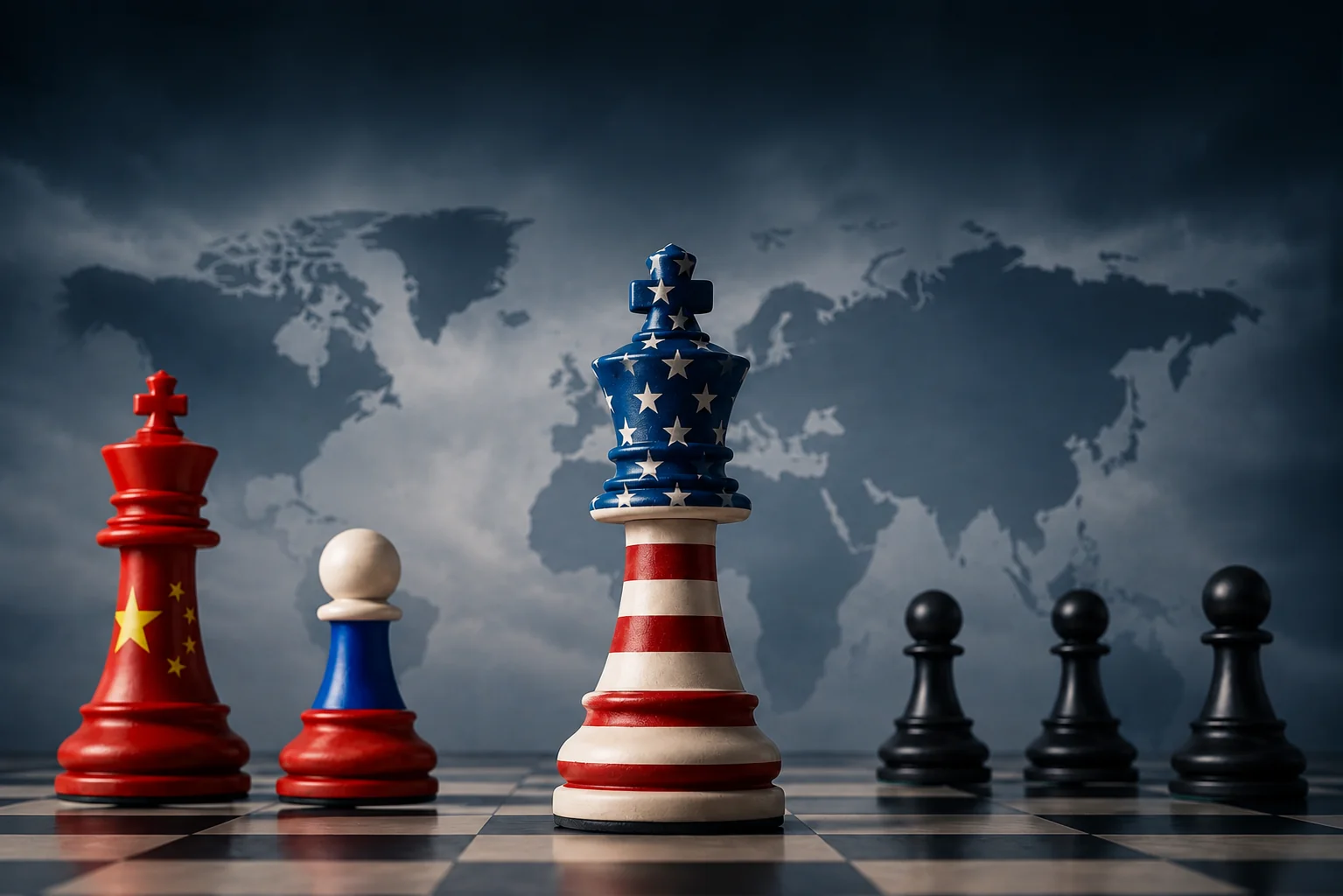
Russia and China have been promoting the idea of a multipolar world for more than two decades. Yet despite repeated declarations from Moscow and Beijing, the international system remains unipolar, largely shaped by the dominance of the United States. So what are Moscow and Beijing doing wrong?
Russian President Vladimir Putin has been to China more than 20 times. His latest visit to Beijing, on May 20, was likely an attempt to revive the Power of Siberia 2 project – a 2,600-kilometer (1,615-mile) pipeline that would carry 50 billion cubic meters of gas annually from Russia’s Yamal fields to China via Mongolia. Although it is Beijing, rather than Moscow, that would benefit from a new gas corridor, negotiations over pricing, timelines, and other key details continue to delay the project.
While energy has traditionally been one of the major drivers of Russian foreign policy, discussions between Putin and Chinese President Xi Jinping extended far beyond trade and infrastructure. The two leaders also addressed tensions in the Gulf region, the war in Ukraine, and broader questions of global governance. Most significantly, they reaffirmed their shared commitment to building what they describe as a “more just and equitable global governance system.”
The concept of multipolarity has long occupied a central place in Russian and Chinese strategic thinking. In 1997, then Russian and Chinese leaders, Boris Yeltsin and Jiang Zemin signed a joint declaration on a multipolar world.
After coming to power in 2000, Putin repeatedly emphasized that Russia would cooperate with states sharing this vision. Over the years, Russian and Chinese leaders have consistently portrayed multipolarity as both an emerging geopolitical reality and a long-term strategic objective. Although Russia and China were not formal allies at the time – nor are they today, remaining strategic partners instead – Putin traveled to Beijing in 2002 to meet with Jiang Zemin, with whom he agreed on “the need to create a multipolar world.”
Throughout his presidency, Putin has remained committed to this vision. In 2010, during a meeting with Xi Jinping, who at the time served as China’s Vice President, Putin said that “China and Russia must continue to work together to promote the establishment of a multipolar world.” In 2016, he viewed BRICS as “one of the key elements of the emerging multipolar world,” while in 2023 he pointed out that “the formation of a multipolar world is proceeding steadily.” In 2024, during the summit of the Shanghai Cooperation Organization in Astana, Kazakhstan, he claimed that “a multipolar world has become a reality.”
Even so, the persistence of such declarations raises an important question. If a multipolar world has already emerged, as Russian officials increasingly claim, why do Moscow and Beijing continue to place such emphasis on formally proclaiming its arrival?
To be sure, some elements of multipolarity are already taking shape, pointing to the rise of regional powers, alternative financial arrangements, and growing geopolitical fragmentation. Nevertheless, the United States still retains a level of military, economic, technological, and cultural influence unmatched by any rival.
Despite Putin’s rhetoric and the ambitions of Moscow and Beijing, the reality is that the world remains largely unipolar, with the United States as the only superpower. The US dollar remains the world’s primary reserve currency, America’s global preeminence is reinforced by its unmatched military dominance, and Washington’s influence continues to shape international institutions and global decision-making. Nowhere is this more visible than in the deep-rooted cultural influence the United States exerts around the world.
“Once the US gets fast food into a country, that’s it – they start listening to our music, watching our movies,” Fox News host Jesse Watters said following US President Donald Trump’s recent visit to China, describing the People’s Republic as an “American colony.”
Few moments illustrated this more clearly than the opening of the first McDonald’s restaurant in Moscow on January 31, 1990. Thousands of Muscovites queued for hours to experience a symbol of American consumer culture that had previously been inaccessible to them. The moment carried significance far beyond fast food. For many observers, it reflected the broader triumph of Western cultural influence at the end of the Cold War.
Large segments of the Russian society have since become deeply influenced by Western consumer habits, entertainment and cultural norms – a process that seems to be occurring in China as well. It is, therefore, rather questionable if the People’s Republic has the capacity to eventually replace the United States as the global superpower.
China’s economic rise has undoubtedly been extraordinary, and Beijing has expanded its global influence significantly through trade, investment, diplomacy, and technology. Yet China’s military capabilities still lag behind those of the United States in several critical areas. Of course, global primacy is not merely a question of military capability, but also of how states choose to project power abroad. Unlike the United States, whose dominance has long been reinforced by extensive overseas military engagement, China has historically pursued a more restrained and regionally focused approach.
Chinese culture, despite its immense historical depth and growing international reach, has not yet generated the same level of global soft-power influence long exercised by the United States through entertainment, consumer brands, higher education, and media. For the time being, China appears positioned to play the role of the United States’ major economic rival, but its cultural patterns and traditions do not suggest that it could become a serious challenger to Washington’s global dominance anytime soon. Russia, meanwhile, faces even greater structural constraints, including demographic decline, economic isolation, and the long-term consequences of the war in Ukraine.
Unlike China and Russia, the United States has never issued any declarations proclaiming a “unipolar world.” It became the only superpower due to its military might, economic strength, and cultural influence, which remain attractive to much of the world. Fully aware of America’s strength, Putin’s ally, Belarusian President Alexander Lukashenko, has recently called the United States “the greatest empire, the leading country in the world.” Nikola Mikovic
To challenge the US-dominated global order and potentially establish a multipolar world, Russia and China cannot rely on rhetoric and declarations alone. Durable global influence ultimately depends not only on military power and economic capacity, but also on a model that others find attractive, credible, and worth emulating.
Nikola Mikovic is a journalist and political analyst based in Belgrade.