
Four Years On, Settlement or Attrition in Ukraine
by Cesar Jaramillo | February 26, 2026
Four years into the Ukraine war, much of what can reasonably be said about how the conflict will likely end was already apparent within its first four weeks.
Fundamentals have changed little: a negotiated settlement remains the most plausible outcome, nuclear risk continues to limit NATO intervention, and neither military victory, nor the recovery of large swaths of territory, nor NATO membership is realistically in the cards for Ukraine – no matter the extent of Western military support.
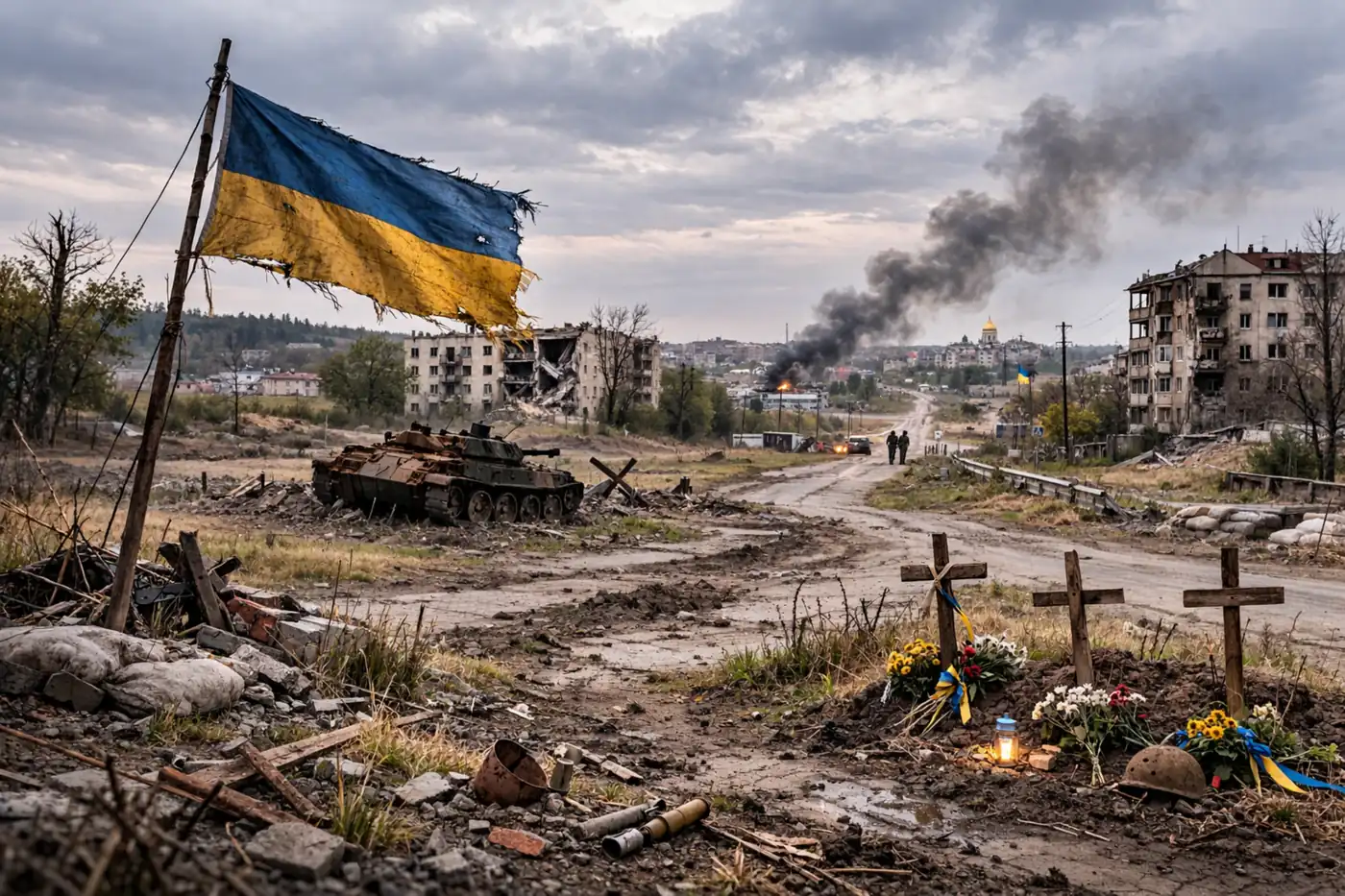
What has changed, profoundly, is the scale of the devastation. The number of graves has grown dramatically, with hundreds of thousands of casualties among young Russians and Ukrainians, and millions of lives upended, even as the strategic logic of the war and its likely end remains stubbornly unchanged. The humanitarian toll is not only a moral tragedy; it is a strategic one, shaping regional stability, economic recovery, demographic trends, and the long-term political landscape of Europe.
The rapid proliferation of drones on both sides has reshaped the battlefield in ways that deepen mutual pain and elevate escalation risks. This dynamic leaves each side both technically able and strategically incentivized to retaliate, normalizing incessant strikes and eroding barriers to further violence even as neither achieves decisive advantage.
From the outset, sober analysis should have pointed to several entirely predictable realities. Political calculations, however, often led to their dismissal. Chief among them was this: any eventual peace would require negotiation and compromise, including on issues once described as non-negotiable. Ongoing diplomatic efforts, including recent talks in Geneva and preparations for further negotiations, should be seized as an opportunity to confront the structural limits of the conflict and to advance the serious political work required to bring it to an end.
Critically, there is a persistent class of actors for whom the perpetuation of the war carries ongoing benefit. Major weapons manufacturers have reported increased revenues and profits tied to arms orders linked to the conflict. In a war of attrition, steady demand for artillery, missiles, air defences, and related systems sustains production lines even as the human toll rises.
Recognizing this dynamic does not deny legitimate defence needs. It does, however, highlight that economic incentives for prolonged conflict can and often do shape political discourse and policy priorities in ways that complicate or disincentivize de-escalation.
Anniversaries invite reflection. This one should invite honesty and pragmatism.
Strategic Limits
Western military assistance to Ukraine has been extraordinary in scope and scale. It has enabled Ukraine to defend its sovereignty and avoid collapse in the face of Russia’s aggression. That support has mattered enormously, but it has not produced the conditions for military victory.
The illusion that a clear military victory for Ukraine was achievable, if only sufficient weapons are delivered, has been perpetuated by Western policymakers and Ukrainian leaders alike. Yet it rests on increasingly thin strategic evidence, especially now that the war has predictably hardened into one of attrition. Territorial lines shift in painstakingly small increments, at extraordinary human cost, while the broader strategic picture remains largely intact.
Ukraine’s resistance and determination in the face of Russian aggression, however admirable, cannot obscure an uncomfortable truth: even the most valiant efforts can reach the point of diminishing strategic returns if the underlying conditions of the conflict remain unchanged.
Moreover, while democratic governments can mobilize impressive levels of support, they operate within electoral cycles, fiscal pressures, and shifting public priorities. Sustaining open-ended military commitments becomes increasingly complex over time.
Russia’s leadership, by contrast, has framed the war as existential and has shown a willingness to absorb heavy losses in pursuit of strategic objectives. This asymmetry does not imply moral equivalence, nor does it diminish responsibility for aggression. It does, however, shape the strategic landscape.
It remains more plausible that Western unity will fray at the margins than that Russia will abruptly abandon what it defines as core security goals. President Trump’s positions on the conflict, increasingly at odds with Europe’s priorities and strategic objectives, are already exposing deep cracks in Western unity.
Policymakers would also do well to recognize that Ukraine’s accession to NATO during or immediately after the war remains highly improbable and deeply destabilizing. Even those most supportive of Ukraine should know that direct NATO intervention would carry unacceptable risks of confrontation between nuclear-armed powers. Perhaps more uncomfortable for some to acknowledge is a broader geopolitical reality: no major power today would accept an immediate neighbour joining an adversarial nuclear alliance.
The Nuclear Shadow
The war in Ukraine has unfolded under the persistent shadow of nuclear weapons, which have been explicitly – and irresponsibly – invoked by the Russian leadership. Russia’s arsenal does not prevent conventional war, but it does limit the range of responses available to NATO. It explains why Western support has been calibrated rather than unlimited and why direct intervention has been avoided.
This is not to say that nuclear deterrence has delivered stability; far from it. Russia’s nuclear weapons have enabled it to pursue aggressive objectives while deterring direct military retaliation by other nuclear-armed states. That dynamic does not create peace. It creates a prolonged and dangerous equilibrium in which escalation risks remain ever present, including the possibility of catastrophic nuclear use by miscalculation or design.
In simple terms, this is how irremediably destabilizing nuclear weapons can be: they are always subject to abuse while the international community is left with limited recourse. And a war between a non-nuclear power and a nuclear power is unlikely to end in a decisive defeat of the latter.
For those who ask whether Russian nuclear blackmail can succeed, the uncomfortable answer is that, to some extent, it already has. And it rests on the same deterrence logic shared by all nuclear-armed states. The structural problem lies not only in leadership choices but in the continued existence of the weapons themselves. And the only definitive remedy remains their elimination.
The Need for a Negotiated Settlement
If the war does not end in decisive victory, and if escalation is structurally constrained, then the logical conclusion remains what it was early in 2022: the conflict will end through negotiation. The more relevant question is not whether a settlement will occur, but how much additional death and destruction will precede it.
Negotiation will require concessions from all parties. Issues that have been described as fixed or absolute will become subjects of compromise. Peace settlements rarely align perfectly with moral expectations. They reflect power realities, security concerns, and the exhaustion of alternatives. Equally important, negotiation will not emerge automatically from stalemate. It requires sustained diplomatic investment and, critically, the willingness to reach an agreement.
Any durable agreement will also need to acknowledge the security concerns of both sides. Recognition is not endorsement. It is acknowledgment that perceived threats shape state behaviour. Ukraine seeks credible guarantees against future aggression and restoration of sovereignty. Russia seeks limits on NATO expansion and strategic encroachment. Ignoring either side’s stated security concerns will not produce stability.
The eventual outcome is unlikely to satisfy all observers and will be described by some as unjust. It will most likely fall short of full territorial restoration for Ukraine. Russia will not achieve its maximalist goals. Yet the alternative is continued attrition without a coherent strategy or endgame.
Pragmatism Over Illusion
Public discourse surrounding Ukraine has often been framed in moral absolutes. Moral clarity is understandable in the face of aggression. But policy must be guided by sober assessments as well as principle.
To be sure, supporting Ukraine militarily and pursuing diplomacy are not mutually exclusive objectives. A parallel commitment to both may offer the best prospect for reducing violence while preserving space for negotiation. But framing diplomacy as capitulation risks foreclosing options that could ultimately save lives.
The pragmatism required to end this war does not equate to appeasement. It recognizes that wars are ended not by rhetoric but by political settlement. It acknowledges that nuclear risk imposes constraints that cannot be wished away. And it recognizes that human lives continue to be lost while policymakers debate maximalist objectives.
Four years into this war, the strategic realities should finally take precedence over the rhetoric surrounding them. None of this negates Ukraine’s right to defend itself or Russia’s responsibility for launching an illegal war. But ignoring structural constraints does not strengthen policy; it weakens it.
The tragedy is not only that the war continues, but that the contours of its likely end have been visible for years. Each additional month of attrition reinforces what was clear from the start: this conflict will end through negotiation, not military defeat. The question is how many more deaths will precede that much-needed settlement.
Cesar Jaramillo is Executive Director at SANE Policy Institute.