
A Broken Global Order – Long Before Trump
by Cesar Jaramillo | January 22, 2026
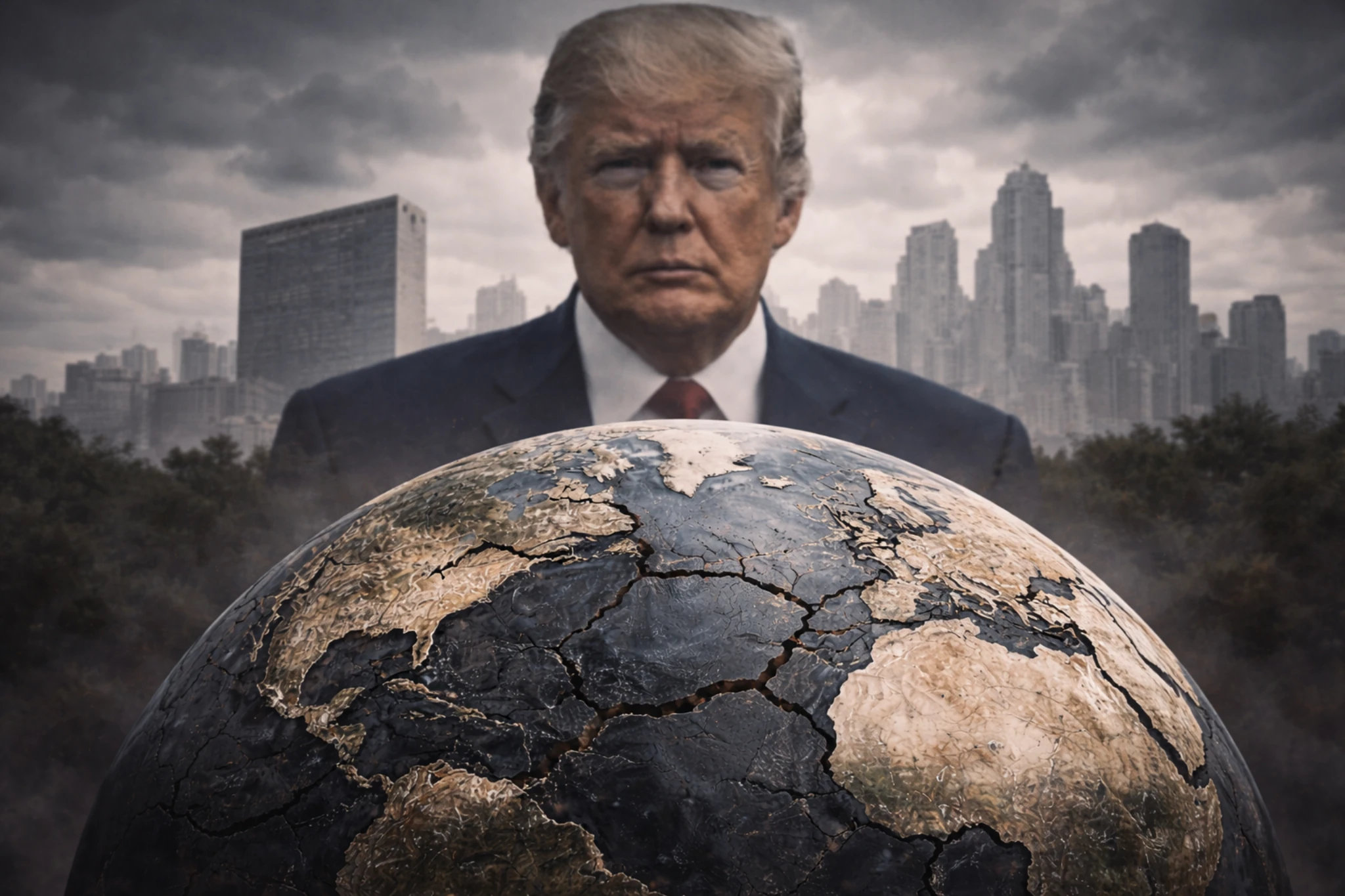
One year into Donald Trump’s disruptive second term, we are increasingly being told that the rules-based international order is finished. That the age of restraint is over, and that we are back in a world of raw power, spheres of influence, and open intimidation.
Western leaders are now starting to more forcefully denounce a rupture in the international system and to call for pragmatic realignment. They are correct. But a more honest reckoning is still needed – not just with the erosion and shortcomings of the global order, but, crucially, with the role they themselves have played in its decline.
The global order was not simply attacked from the outside by Donald Trump. It had been hollowed out from within for years. Long before it began to threaten Western interests directly – from talk of taking Greenland, to threats of annexing Canada, to weaponizing tariffs against allies, to undermining Europe’s objectives in Ukraine – it had already been weakened by the selective way it was applied, defended, and, when convenient, set aside by those who claimed to be its guardians.
Until recently, many of those now lamenting the consequences of Mr. Trump’s behaviour responded not with principled resistance, but with acquiescence. What should have been treated as a fundamental challenge to the very architecture Western states claim to uphold was absorbed in the name of alliance management and strategic convenience.
It is now, when Western territorial integrity itself is spoken of casually, and when the prospect of direct threats enters the picture, that alarm has become audible. Greenland has accomplished what countless transgressions on other fronts apparently had not: it has made the erosion of norms feel personal for the West.
Complicity before collapse
For much of the world, the Western alarm now surrounding the collapse of norms does not land as revelation, but as recognition.
If you are a Palestinian enduring relentless Israeli assaults while pleading for international humanitarian law to be upheld by those who claim to be its champions; if you are an Iraqi whose country was invaded under false pretences, only to be told afterward that the legal arguments were beside the point; if you are a Latin American whose political life has been shaped for decades by electoral interference, sanctions, coups, and economic coercion dressed up as democracy promotion; if you are an African whose primary encounter with the West comes through cobalt extraction, land grabs, and supply chains that value resources far more than lives.
If you are Sudanese watching the world avert its gaze as hundreds of thousands are slaughtered with little more than ritual expressions of concern; if you are a refugee fleeing a war fuelled by Western weapons, only to be turned away at the borders of the very states that profited from it; if you are a Saudi civilian who has lived under repression enabled by Western arms, intelligence, and diplomatic cover; if you are an Iranian who watched your country comply with the terms of the JCPOA only to see sanctions snap back regardless; if you are Afghan, Libyan, or Syrian, promised liberation and delivered chaos.
If you are a Eurasian watching the casual extension of NATO’s military infrastructure ever closer to Russia’s borders, with little regard for how security dilemmas are created and escalation risks normalized; if you are any citizen on Earth living under the shadow of nuclear catastrophe, watching nuclear-armed states modernize their arsenals, abandon arms-control obligations, and treat disarmament commitments as optional rather than binding – then the system whose breakdown is now being mourned did not fail recently. For many, it failed long ago.
In those contexts, and many more, the talk of a sudden rupture in the international system can sound surreal. Coercion, selective law, instrumentalized humanitarianism, and disposable sovereignty have not arrived with Trump. What is new is not the behaviour itself, but the fact that it is now unsettling those who long assumed the order’s protections were meant for them.
Worn-out system
The erosion has been visible for some time. Nowhere has it recently been more damaging, more revealing, or more consequential than in the Western response to Israel’s assault on Gaza after the Hamas attacks of October 7, 2023, and the ongoing expansion of illegal settlements in the occupied Palestinian territory.
Faced with mass civilian devastation, clear legal violations, and repeated warnings from humanitarian agencies and international bodies, Western governments focused less on enforcing the law than on emptying it of meaning. Legal language flowed even as accountability was blocked. Red lines were repeated even as they were crossed. The message to the world was unmistakable: double standards, and a reluctance to defend international law when it became politically inconvenient.
Indeed, much of what is now described in Europe and North America as a shocking break in international behaviour would not sound new in large parts of the world. From the colonial scars of Africa, to repeated military interventions and proxy wars across the Middle East – perpetually on fire with Western weapons and intervention – to the generational trauma inflicted on Palestinians, to decades of destabilization in Latin America and beyond, the patterns now provoking alarm in Western capitals have been lived realities elsewhere for much longer.
Given the scale of U.S. economic power and military reach, the reverberations are inevitably louder. Still, for much of the postwar period, the richest and most powerful states have occupied a protected position in a system in which violence, inequality, and violations of international law could be tolerated at the periphery while stability was enjoyed at the centre. The rules-based order, such as it functioned, offered uneven protection, shielding some while leaving others exposed.
Ideals worth defending
The present rupture is not simply the product of a single presidency, even if Donald Trump has undeniably accelerated the decline and raised the stakes. It is what happens when years of accommodation, selective enforcement, and eroding credibility finally catch up and begin to collapse back on those who once thought themselves insulated.
Still, the idea that international life can be organized around something other than coercion cannot be abandoned. The international community must not accept a world in which the rule of law, multilateralism, and collective restraint are dismissed as obsolete relics. It is certainly true that the global order built after 1945 has been flawed and unevenly applied in practice. But the principles it was meant to serve remain among the most serious civilizational advances ever made.
These principles did not eliminate conflict, but they made aggression harder to justify. They narrowed the circumstances under which violence could be defended. They laid the foundations of the UN Charter and international humanitarian law, embedding the idea that even when war occurs, it is constrained by obligations to civilians, proportionality, and human dignity. They also made possible arms-control and disarmament regimes that treated unrestrained militarization not as a permanent fact of life, but as a shared danger requiring collective management.
From the Geneva Conventions to nuclear disarmament and non-proliferation, from bans on chemical weapons to limits on landmines and cluster munitions, these efforts reflected a growing recognition that security built purely on violence is not tenable.
A world without those constraints will not be more stable. It will be more violent, more unequal, and more permanently dangerous. The turmoil of the present moment is therefore not an argument for abandoning the ideals that were betrayed. It is the strongest argument for why they matter.
The question now confronting democratic societies, middle powers, and multilateral institutions is whether they are finally willing to apply those principles, even when doing so carries political cost. If governments are unwilling to pay those costs – with allies, with arms exports, with sanctions, with vetoes, with political discomfort – then what is collapsing is not only the international order, but the credibility of those who claim to stand for it.
Cesar Jaramillo is Executive Director at SANE Policy Institute.