
Mali’s Unfinished War
by María Pía Devoto | June 25, 2026
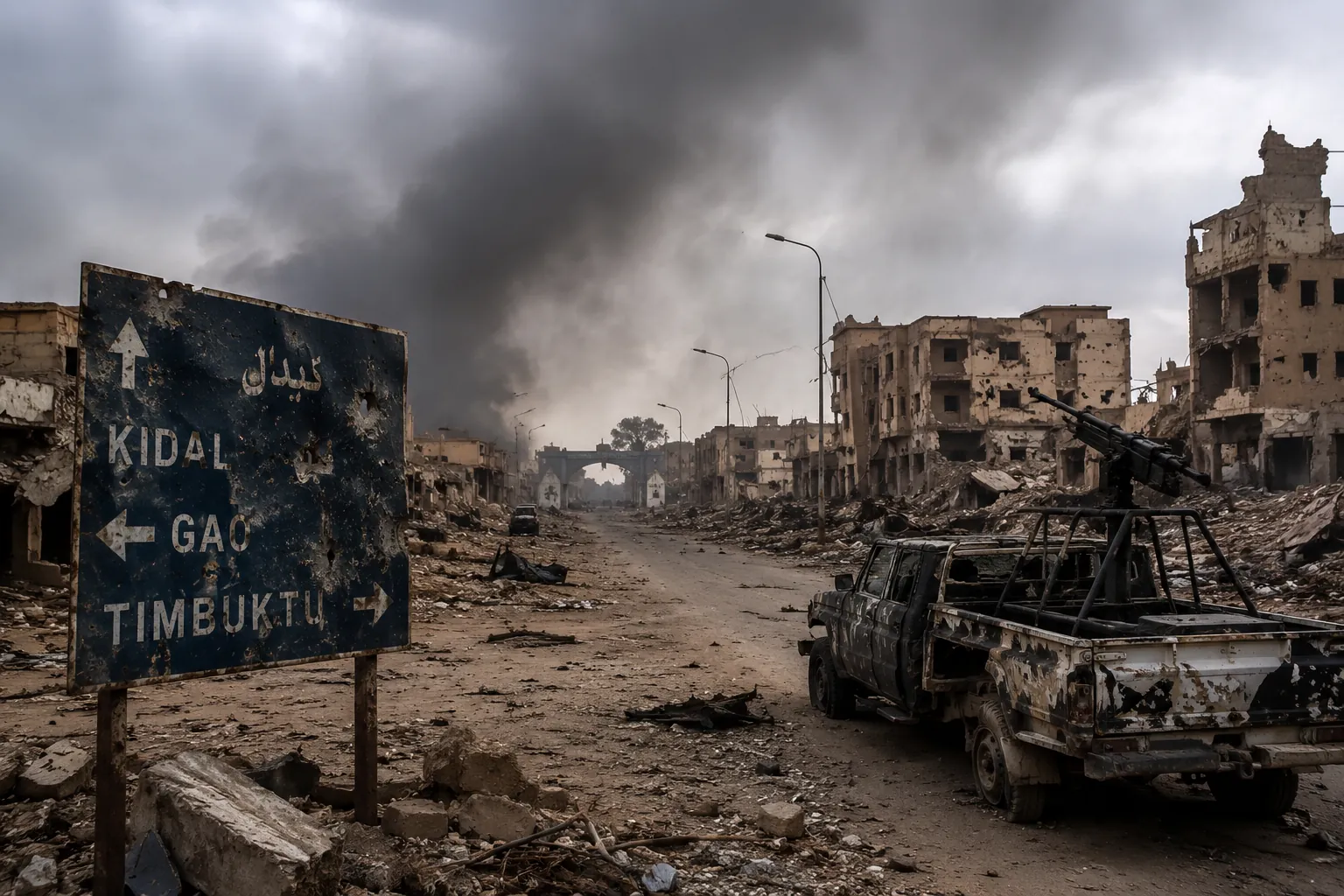
Mali is once again at a dangerous crossroads. More than a decade after the current crisis first erupted, the country remains trapped in a cycle of insurgency, military intervention, and political instability. The convergence of Tuareg separatism, jihadist expansion, state fragility, and geopolitical competition now threatens not only Mali itself, but the stability of the wider Sahel region.
Although the current phase of the crisis began in 2012, violence escalated sharply in April 2026 following coordinated attacks by Tuareg and jihadist forces. These attacks came after the withdrawal of international missions and the collapse of peace agreements that had long struggled to contain the conflict.
Understanding the roots of today’s crisis requires looking beyond recent events.
The Mali Empire, which existed between 1235 and 1645, was renowned for its wealth, particularly its gold production and control of trans-Saharan trade routes. It was also an important cultural and intellectual centre of the Islamic world, with cities such as Timbuktu becoming symbols of scholarship and commerce.
Over the centuries, other empires rose and fell before the territory came under French colonial rule in the late nineteenth century. Like much of Africa, Mali’s modern borders were shaped by European powers with little regard for local realities. The result was the creation of a state encompassing communities with distinct identities, interests, and historical experiences, making political coexistence difficult after independence.
Among those communities are the Tuareg, a predominantly Amazigh (Berber) people with a semi-nomadic tradition whose presence extends across Mali, Niger, Algeria, and Libya. Since Mali’s independence in 1960, relations between Tuareg communities and the government in Bamako have been marked by political marginalization, limited state presence, and recurring demands for autonomy. Rebellions in the 1960s, 1990s, and 2000s produced a series of peace agreements that promised decentralization and integration but were never fully implemented.
In 2012, a major Tuareg rebellion sought the independence of northern Mali, known as Azawad. Supported by jihadist groups, rebel forces seized key northern centres including Gao, Timbuktu, and Kidal. Jihadist organizations had already established a foothold in the region, aided by weak state institutions, porous borders, and the influx of fighters and weapons following the collapse of Muammar Gaddafi’s regime in Libya. Their influence grew steadily across the Sahel, where they promoted an extremist interpretation of Islam and a broader transnational political project.
The international response was swift. The United Nations established the MINUSMA mission in 2013, while France launched Operation Serval, later expanded into Operation Barkhane. Yet despite years of international engagement, terrorism persisted, violence spread, and the 2015 Algiers Accords ultimately collapsed. The coups of 2020 and 2021 further undermined the political framework intended to stabilize the country.
General Assimi Goïta emerged as the central figure in Mali’s new political order. After leading the 2020 coup that removed President Boubacar Keïta, he initially accepted a transitional arrangement under international pressure. Within months, however, he consolidated power by removing the transitional president and establishing military rule.
Mali subsequently severed many of its security ties with France and the European Union, expelled international missions, and turned increasingly toward Russia. Beginning in 2022, hundreds of Wagner Group personnel arrived to train Malian forces, provide security services, and assist in operations against separatist and jihadist groups. Following the death of Wagner leader Yevgeny Prigozhin, Russia gradually shifted these responsibilities to Africa Corps, which now operates directly under the Russian Ministry of Defence.
A Conflict Internationalized
The most significant military success achieved by the government and Wagner forces was the recapture of Kidal in 2023. Yet rather than ending the conflict, it was followed by the regrouping of separatist movements under the Azawad Liberation Front (FLA) and by a strategic evolution among jihadist organizations. Violence increasingly spread beyond rural areas and into urban centres, including the capital itself.
In April 2026, the FLA and the Group for the Support of Islam and Muslims (JNIM), an organization affiliated with Al-Qaeda, launched coordinated attacks across seven locations, including Bamako and three provincial capitals. Defence Minister Sadio Camara was killed, and rebel forces temporarily regained control of Kidal, forcing Africa Corps to withdraw. Although government forces retook most of the affected cities, continuing blockades have disrupted fuel and food supplies, increased prices, and worsened humanitarian conditions. Despite these setbacks, Goïta appears to retain significant domestic support.
The crisis has also exposed the limitations of the Alliance of Sahel States (AES), the regional bloc established by Mali, Burkina Faso, and Niger following their withdrawal from ECOWAS. While the alliance was created in part to strengthen collective security, its response to the recent escalation has been limited. At the same time, the three governments have pursued closer political, economic, and security cooperation with Russia and China while seeking to reduce dependence on Western partners.
As in many contemporary conflicts, arms continue to flow from multiple sources. Mali receives weapons from Russia, China, and Turkey, including artillery systems, air defence equipment, and drones. Particularly troubling are reports that the Malian air force has employed Russian-made cluster munitions in the Timbuktu region despite Mali being a State Party to the Convention on Cluster Munitions.
Tuareg and jihadist forces rely on different supply networks. Some weapons originate from stockpiles dispersed after the collapse of the Libyan regime in 2011. Others are obtained through smuggling networks, local arms markets, or diversion from military stockpiles across the region. JNIM also acquires weapons through attacks on military facilities and the looting of government and international mission arsenals throughout the Sahel.
The future trajectory of the conflict remains uncertain. Neither international interventions nor military rule backed by Russian support have succeeded in stabilizing the country. Deep structural factors continue to fuel violence: weak state institutions, widespread poverty, longstanding territorial grievances, the proliferation of weapons, corruption, and the continued expansion of extremist groups.
Recent experience suggests that a purely military solution is unlikely to succeed. Nor can long-term stability be achieved simply by outsourcing security to external actors. Should the military government fall, Mali could face a new struggle for power among forces whose objectives are fundamentally incompatible. The FLA seeks greater autonomy or independence for Azawad, while JNIM aims to impose a strict interpretation of sharia across Mali and potentially beyond.
One possible path forward would involve strengthening security cooperation among Mali, Niger, and Burkina Faso while gradually reducing dependence on any single external partner. More importantly, any durable political settlement will require meaningful decentralization, greater local control over resources, and stronger representation of Tuareg communities within state institutions. Mali has become a reflection of many of the contradictions that define today’s Sahel: weak states, unresolved identity disputes, geopolitical competition, expanding extremist movements, and the uncontrolled circulation of weapons.
None of the approaches attempted thus far – international intervention, military rule, or reliance on external security actors – has produced sustainable peace. While global attention remains fixed elsewhere, Mali continues to deteriorate largely out of sight. Without an inclusive political process that addresses historical grievances, strengthens institutions, and reduces incentives for armed violence, not only Mali’s future but the stability of the wider Sahel will remain at risk.
María Pía Devoto is Director of the Association for Public Policies (APP) and founding coordinator of the Human Security Network of Latin America and the Caribbean (SEHLAC).