
Another Violent Year: Civilian Harm and the Erosion of Restraint
by Cesar Jaramillo | July 1, 2026
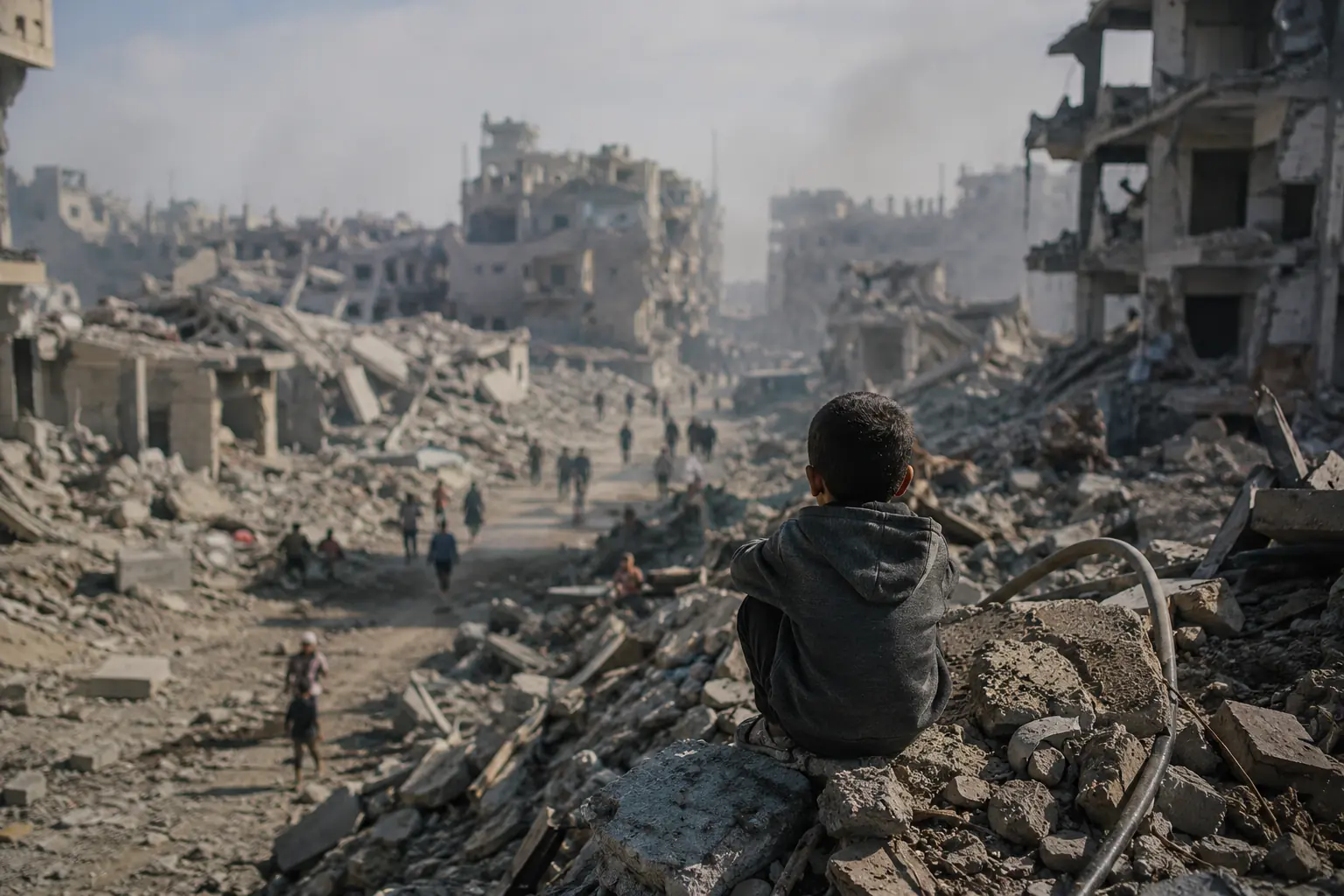
The latest edition of the Explosive Weapons Monitor reveals a deeply troubling pattern of civilian harm in armed conflict. During 2025, both civilians and civilian infrastructure were harmed by explosive weapons in at least 65 countries, territories, and maritime locations, with more than 22,600 civilians killed. Although this represented a decline from the exceptionally high levels recorded in 2024 – driven largely by Israel’s military campaign in Gaza – civilian harm remains alarmingly severe.
Produced annually as a research initiative of the International Network on Explosive Weapons (INEW), the report tracks patterns of explosive weapons use and their humanitarian consequences around the world. It documents attacks affecting healthcare, education, humanitarian operations, food systems, and water infrastructure across numerous conflicts.
Yet perhaps the most significant warning to be drawn from the report is not any single statistic. It is that repeated attacks on civilians risk eroding the sense that such harm is exceptional, unacceptable, and preventable.
According to Katherine Young, Research and Monitoring Manager for the Explosive Weapons Monitor, “For the third consecutive year, we have documented civilian harm on a massive scale that now appears routine rather than exceptional. When the bombing and shelling of towns and cities comes to be expected rather than condemned, we risk normalising suffering that is both foreseeable and preventable.”
This warning deserves far greater attention than it has received.
The normalization of civilian harm is not just a humanitarian concern. It is a political, legal, and moral one. It reflects the gradual erosion of restraints that were painstakingly developed over decades to protect civilians from the worst effects of war.
While armed conflict has long inflicted terrible suffering on civilian populations, the international community did not simply accept this reality as inevitable. The Geneva Conventions, international humanitarian law, and a range of related treaties and norms reflected a collective determination to place limits on how wars are fought.
The principle was straightforward: even when war cannot be prevented, not everything should be permitted. Today, however, those restraints appear increasingly fragile.
In conflict after conflict, images that would once have provoked widespread international outrage have become part of the daily news cycle. Residential neighbourhoods reduced to rubble. Hospitals rendered inoperable. Schools damaged or destroyed. Humanitarian operations disrupted. Water and electricity systems degraded. Civilian casualties reported in the dozens or hundreds and then quickly displaced by the next tragedy.
The report documents a 52 percent increase in incidents involving explosive weapons affecting humanitarian aid operations. Attacks affecting education increased by 64 percent. More than 1,200 incidents affecting healthcare facilities, ambulances, or health workers were recorded. These figures are not merely indicators of violence; they point to the systematic disruption of civilian life.
Who Is Harming Civilians?
One of the report’s most striking findings is that state armed forces were responsible for 85 percent of all incidents affecting civilians and civilian infrastructure. In other words, the primary drivers of documented civilian harm were not actors operating outside the international system, but the very states that have collectively developed and endorsed many of the rules intended to protect civilians.
This challenges a common assumption that disregard for civilian protection is primarily associated with non-state armed groups or actors operating outside accepted international norms. The reality is more uncomfortable. The overwhelming majority of documented incidents affecting civilians were attributed not to insurgents, militias, or terrorist organizations, but to states and their armed forces.
The principal challenge to civilian protection today is not the absence of legal frameworks. The challenge is increasingly one of political will. The rules governing armed conflict require political leaders to accept meaningful constraints on the use of force even when doing so may appear inconvenient from a military perspective.
Governments that rightly condemn violations committed by their adversaries have often proven far more reluctant to address comparable conduct by allies or partners. Such double standards carry significant consequences.
When legal principles are applied selectively, they do not simply lose credibility in a particular case; they risk losing credibility more broadly. Other states observing these inconsistencies may conclude that adherence to international norms is optional, negotiable, or subordinate to geopolitical interests.
The current trend extends beyond a rise in civilian harm. It is a broader process of normative erosion. Destruction that would once have been viewed as exceptional increasingly comes to be regarded as an unfortunate but unavoidable feature of modern warfare – or is explained away through instrumentalized interpretations of the right of self defence or international humanitarian law.
“State armed forces were responsible for the overwhelming majority of this harm, the effects of which reach far beyond those killed, devastating the hospitals, schools, water and food systems that communities depend on to survive,” said Katherine Young. “States must refuse to normalise this toll and should strengthen the protection of civilians by placing real limits on the use of explosive weapons in populated areas.”
Of course, not all conflicts are identical. The political circumstances, legal questions, and strategic contexts vary considerably from one to another, with states and armed groups bearing differing degrees of responsibility. From the perspective of civilians caught in the blast radius of explosive weapons, however, these distinctions often provide little comfort.
Whether in Gaza, Ukraine, Sudan, Myanmar, or elsewhere, civilians experience the destruction of homes, schools, hospitals, and essential infrastructure in remarkably similar ways. Communities are displaced. Public services collapse. Economic activity is disrupted. Recovery becomes increasingly difficult as humanitarian needs multiply.
Importantly, the cumulative effect extends well beyond immediate casualties. The Explosive Weapons Monitor’s findings serve as a reminder that civilian harm cannot be measured solely through death tolls. Entire communities can face years of displacement, profound psychological trauma, economic hardship, degraded public services, and reduced access to healthcare, education, food, and clean water. The long-term consequences of explosive weapons use often persist long after active hostilities have ended.
From Political Commitment to Implementation
This reality reinforces the importance of efforts to strengthen protections for civilians, including through the Political Declaration on Strengthening the Protection of Civilians from the Humanitarian Consequences of the Use of Explosive Weapons in Populated Areas.
Meaningful as it is, however, such instruments will only be as effective as the commitment behind them. The report notes that incidents causing civilian harm were attributed to a growing number of states that have endorsed the Declaration, increasing from five endorsing states in 2024 to eight in 2025.
This does not diminish the Declaration’s importance. Rather, it underscores the importance of implementation. Political commitments must be translated into military doctrine, operational practice, training, and accountability mechanisms if they are to reduce civilian harm in practice.
As INEW Global Lead Júlia Codina notes, the Declaration is a starting point, not an endpoint. “It commits states to change how their forces operate in populated areas, and we have always known that changing military practice is a long-term undertaking. The gap between endorsement and operationalisation remains wide, and a commitment of this kind will not prevent civilian harm until it changes practice on the ground.”
The challenge facing governments today is not merely to endorse norms, but to demonstrate through their actions that those norms matter. That means reviewing military doctrine, strengthening civilian protection policies, supporting transparency and accountability, and applying standards consistently regardless of the parties involved.
The implications extend beyond military doctrine. Efforts to strengthen civilian protection cannot be separated from decisions about the transfer of conventional weapons. Where there is a clear risk that exported weapons may be used in ways inconsistent with international humanitarian law or contribute to patterns of civilian harm, restraint should apply not only to how weapons are used, but also to whether they are supplied in the first place.
In this context, the purpose of documenting civilian harm is not merely to count casualties or catalogue destruction. It is to preserve visibility, accountability and, ultimately, restraint. The troubling pattern of civilian harm documented in the Explosive Weapons Monitor should therefore be understood not simply as a description of current realities, but as a test of whether the international community still believes that limits in war matter.
If extraordinarily high levels of civilian harm become accepted as normal, the protections developed over generations will continue to weaken. If, however, these trends are recognized for what they are – evidence of an alarming erosion of restraint – there remains an opportunity to reverse course. The first step is refusing to treat the unacceptable as routine.
Cesar Jaramillo is Executive Director at SANE Policy Institute.