
Beyond Strongly Worded Statements:
Ten Concrete Actions to Press for Nuclear Disarmament
by Cesar Jaramillo | April 27, 2026
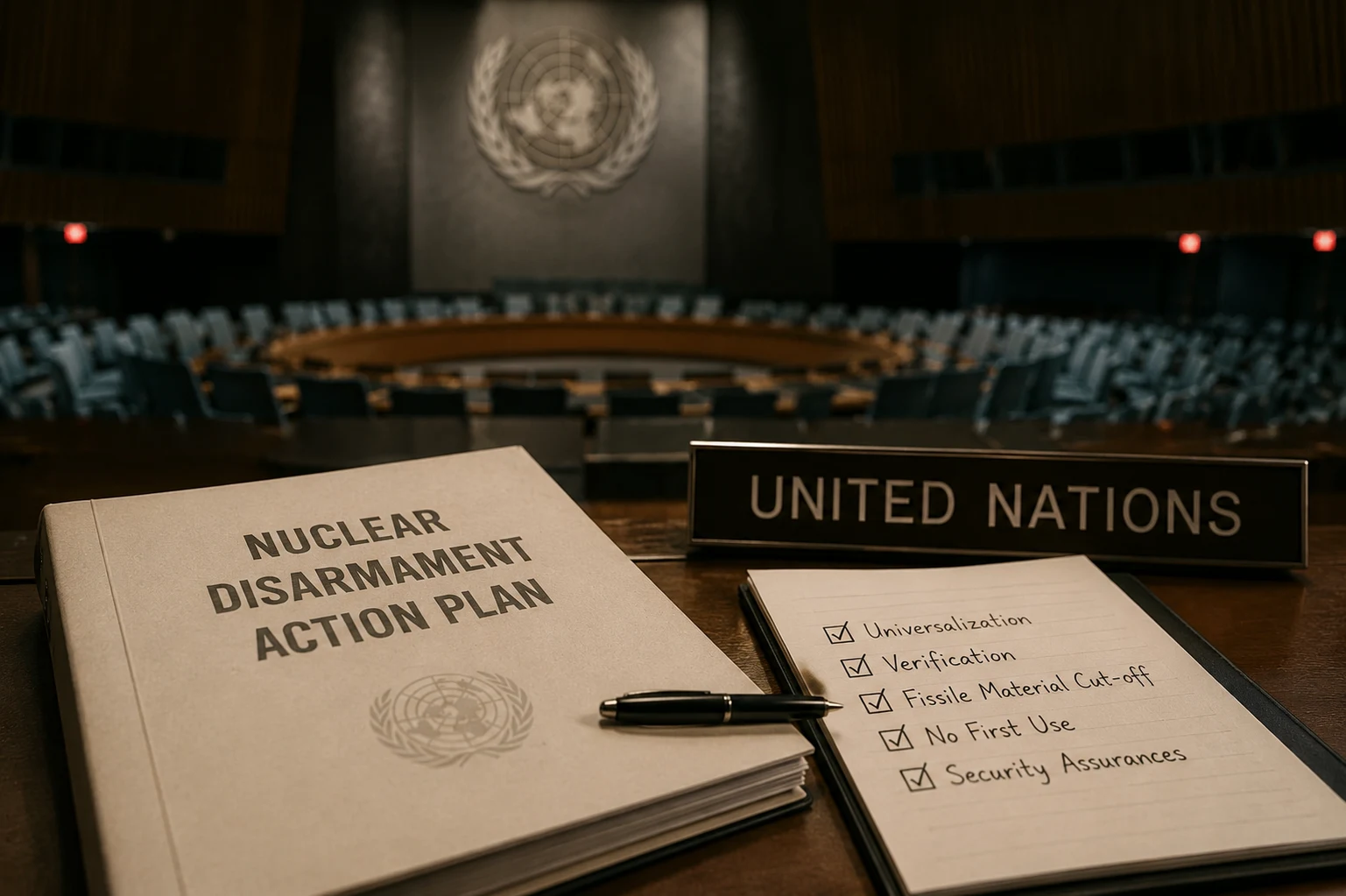
Nuclear weapons are routinely described as the gravest threat to humanity. The language is familiar, almost ritualistic. Leaders of non-nuclear-weapon states, increasingly frustrated by the lack of progress toward abolition, reiterate warnings about existential risk, catastrophic consequences, and the shared responsibility to prevent nuclear war. Yet much of the available leverage remains untapped.
As the 2026 Nuclear Non-Proliferation Treaty (NPT) Review Conference opens, the question is not whether these warnings will be repeated, but whether they will be acted upon. If nuclear weapons truly are the gravest threat, then state behaviour should look very different.
Policies would reflect urgency. Alliances would be held to account for their reliance on nuclear deterrence. Financial flows sustaining nuclear arsenals would be treated as politically and ethically unacceptable. Diplomatic engagement would impose costs, not simply register concern. Governments would not continue to support, enable, or quietly accommodate the indefinite modernization of weapons they consider incompatible with nuclear disarmament.
Instead, the dominant pattern is one of managed contradiction. States affirm disarmament while adapting to its absence and warn of nuclear danger while leaving the systems that sustain it largely intact.
Nowhere is this contradiction more visible than in the functioning of the Nuclear Non-Proliferation Treaty itself. Review cycles have become highly choreographed exercises in language management, where success is often measured not by substantive progress, but by the ability to produce consensus text that is subsequently ignored. Commitments are reaffirmed, principles restated, and familiar formulations recycled, even as the underlying trajectory moves steadily in the opposite direction.
At the centre of this dynamic is the persistent failure of nuclear-weapon states to meet their disarmament obligations. Article VI is routinely invoked but rarely operationalized. Concrete steps are diluted, deferred, or blocked outright. Efforts to strengthen accountability are resisted. Even modest advances on risk reduction, transparency, or doctrinal restraint are often treated as concessions rather than responsibilities.
In recent cycles, this pattern has hardened into open obstruction. Red lines are drawn not to advance disarmament, but to prevent it. Language is negotiated down to the lowest common denominator or rejected altogether. The result is not only paralysis, but erosion: of trust in the process, of confidence in the regime, and of the credibility of disarmament commitments themselves.
Expanding the Toolbox
It is not that governments lack tools. But the prevailing approach has long shown its limits. Too often, discussions about what non-nuclear-weapon states can do rely on language that sounds active but is, in practice, empty. Governments and other stakeholders “urge,” “encourage,” “call upon,” or “express concern.” These formulations create the appearance of movement, but they rarely translate into action.
What does it mean, in concrete terms, to “urge” a nuclear-armed state to disarm? What follows if that urging is ignored, as it almost always is? In most cases, the answer is nothing – and the pattern simply repeats, with little consequence or change in behaviour.
This is not a semantic issue. It is a structural one. As long as the primary tools available to non-nuclear-weapon states are framed in terms of persuasion without consequence, their influence will remain limited. If disarmament is to advance, the question cannot simply be how states express their position, but how they act on it.
What costs are imposed, what policies are adjusted, and what forms of cooperation are made conditional? Might, for example, visa restrictions for officials directly involved in the nuclear weapons enterprise be a viable option? Sanctions on the basis of non-compliance?
Responding to the nuclear weapons threat with the seriousness it demands requires more than reaffirming long-term goals. It requires deploying the full range of political, legal, economic, and security levers already available to states.
Another NPT review cycle built on carefully balanced language will produce a familiar outcome. Only the imposition of cost, the setting of conditions, and the testing of commitments can begin to alter the trajectory.
Ten Concrete Actions States Can Take Now
- Make endorsement of the final outcome document conditional on concrete benchmarks, targets, and timelines for disarmament
States should make clear from the outset that endorsement of the final outcome document is contingent on measurable progress, including defined benchmarks, time-bound targets, and credible implementation steps. This conditionality should shape positions throughout the negotiating process, including on draft texts and intermediary language. Without such standards, consensus risks entrenching drift rather than advancing disarmament, and should not be treated as an end in itself but as a means to achieve concrete outcomes.
- Link diplomatic cooperation to disarmament progress
States should begin linking broader diplomatic engagement to measurable progress on nuclear risk reduction and disarmament. This does not require across-the-board confrontation, but rather the deliberate use of leverage where it exists. Areas of cooperation – political, economic, or security-related – should not remain insulated from nuclear policy when disarmament commitments are being ignored or actively resisted. Selective conditionality can signal seriousness without undermining broader relationships.
- Oppose and actively undermine nuclear modernization programs
States should move beyond rhetorical concern and directly challenge the expansion and modernization of nuclear arsenals. This includes coordinated diplomatic pressure, public opposition to specific programs, and refusal to support industrial or technological cooperation that enables modernization. Where existing export controls, procurement rules, or financial regulations allow such contributions, they should be strengthened or replaced to close those gaps and ensure national policies do not enable what states publicly oppose.
- Operationalize the TPNW’s 2MSP indictment of non-compliance
States Parties to the TPNW should build on the Second Meeting’s unprecedented and explicit declaration that nuclear-weapon states have “unquestionably” failed to meet their legally-binding obligations under Article VI of the NPT, and draw out its practical, legal, and political implications. This includes consistently referencing the finding of non-compliance in diplomatic engagement, integrating it into national and multilateral positions, and using it to shape expectations of state behaviour across forums.
- Restrict financial and industrial support for nuclear weapons
Governments should actively restrict public financing tied to nuclear weapons production and require transparency around private sector involvement. Public pension funds, sovereign funds, and state-backed institutions should not be invested in the indefinite maintenance of nuclear arsenals. Financial systems are a largely untapped lever for constraining the material foundations of nuclear weapons and increasing the cost and reputational risk of participation. Civil society initiatives such as ICAN’s Don’t Bank on the Bomb have helped bring greater transparency to such financial links.
- Enact national legislation limiting assistance to nuclear weapon activities
States can further codify their disarmament commitments by restricting forms of material, financial, or technical assistance that contribute to nuclear weapon systems and infrastructure. Such legislation helps close the gap between stated policy and actual practice, ensuring that domestic frameworks do not quietly enable the very activities governments oppose internationally. It also establishes clearer standards for compliance and provides a basis for enforcement and accountability.
- Distance security policy from nuclear deterrence
Governments that rely on extended nuclear deterrence should begin reducing that reliance, including reassessing nuclear-sharing arrangements, opposing forward deployment, and revising doctrines that treat nuclear weapons as central to security. Incremental changes in posture, planning, and doctrine can begin to shift expectations and reduce dependence over time. As long as nuclear weapons remain embedded in security strategies, disarmament will remain an aspirational objective rather than an achievable reality.
- Strengthen and expand coordinated blocs
Isolated action has limited impact. Cross-regional coalitions should work together to press nuclear-armed states consistently, not only during major conferences but in the periods between them. Coordinated positions, shared benchmarks, and sustained, visible engagement can shift political dynamics, increase negotiating leverage, and prevent disarmament from being sidelined in fragmented diplomatic efforts. Collective action also helps reduce the political cost for individual states.
- Extend pressure across multilateral forums
States should ensure that pressure on nuclear-weapon states is not confined to the NPT, but maintained across other multilateral settings, including the UN General Assembly and regional forums. This means regularly raising gaps in disarmament, calling out obstruction, and reinforcing expectations. Sustained cross-forum engagement increases political visibility, limits the ability to deflect criticism within any single process, and helps ensure that accountability is continuous.
- Increase reputational and political costs for inaction
States should challenge misleading narratives, deny diplomatic cover to governments expanding arsenals while invoking disarmament, and oppose the elevation of persistent obstructionists in multilateral forums. Inaction should be framed not as a neutral position, but as a failure to meet obligations, with corresponding political and reputational consequences. Over time, such costs can influence behaviour by affecting credibility, standing, and influence within the international system.
From Rhetoric to Action
None of these steps, on their own, will produce disarmament. Taken together, they would begin to change the political environment in which nuclear weapons are maintained. By introducing costs, constraints, and pressures that are largely absent today, they would begin to alter the dynamics that have long sustained the status quo and normalized continued reliance on nuclear deterrence.
The tools required to shift this dynamic are neither novel nor unavailable. They already exist within the political, legal, economic, and security frameworks that states operate every day, and have been used in other domains to shape behaviour and enforce norms. The question is not whether more can be said, but whether governments are prepared to act in a manner consistent with the gravity of the nuclear weapons threat and the urgency of a solution.
Cesar Jaramillo is Executive Director at SANE Policy Institute.