
Power Plants, Schoolyards, Assassinations:
The Unsettling Normalization of Civilian Targets
by Cesar Jaramillo | April 2, 2026
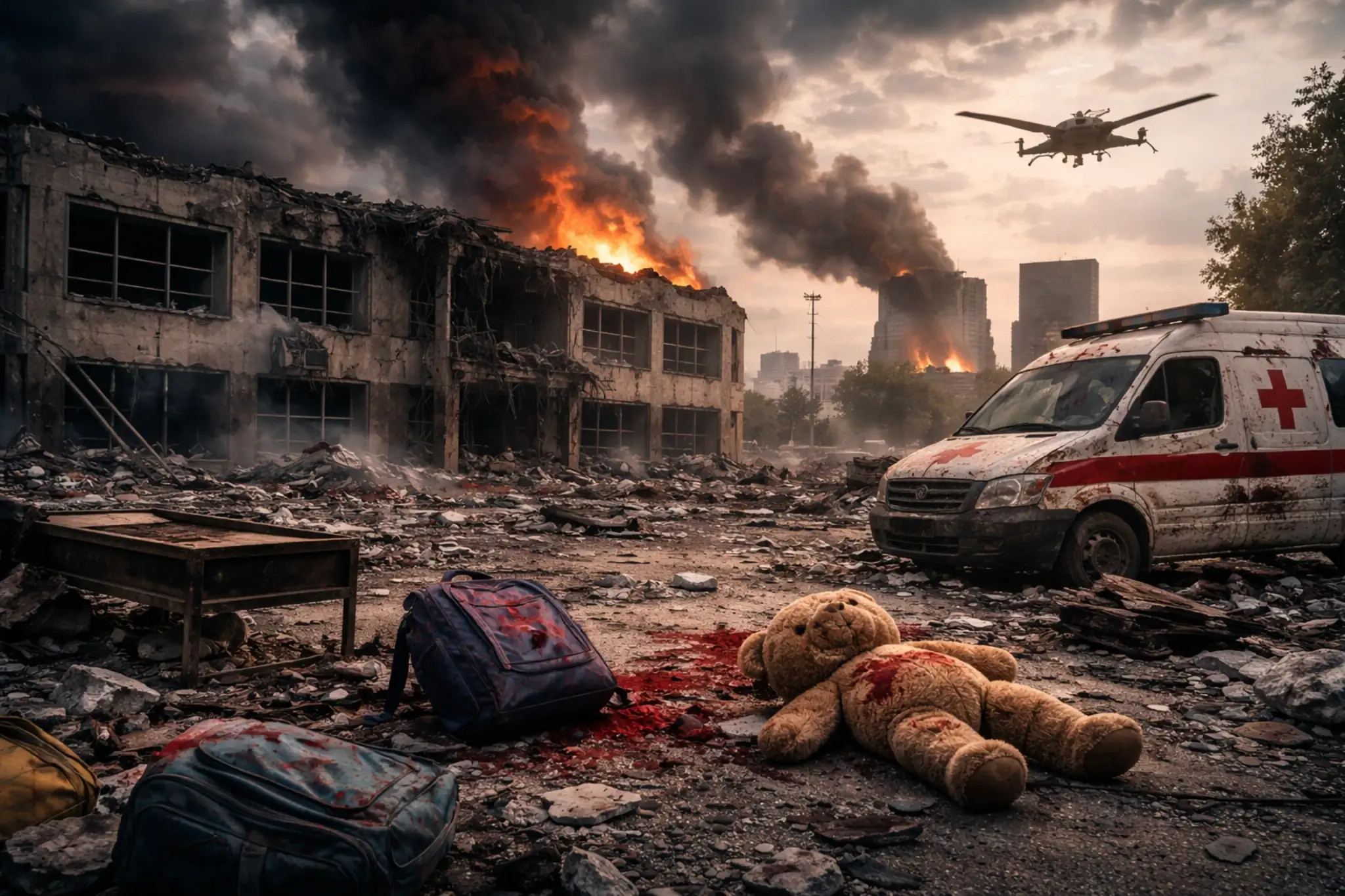
Threats to obliterate Iran’s civilian infrastructure are not coming from rogue military commanders or anonymous sources. They are being issued openly, from the highest levels of the U.S. government, with references to electricity-generating stations, oil facilities, and even desalination plants essential to civilian water supply. Iranian officials have responded in kind, threatening critical infrastructure across the region.
The disdain for restraint is hardly concealed. Senior officials in Washington have moved beyond signalling flexibility in the conduct of war to openly challenging, if not mocking, the value of restraint itself. U.S. Secretary of Defense Pete Hegseth has dismissed rules of engagement as obstacles rather than obligations and made clear that the United States will not fight what he has derided as “politically correct wars.”
Israeli National Security Minister Itamar Ben Gvir has paired similarly hardline rhetoric with stark symbolism, appearing in parliament wearing a noose-shaped lapel pin while advocating legislation expanding the use of the death penalty, widely condemned as specifically targeting Palestinians and constituting a war crime. The law passed. Execution will be carried out by hanging.
In the first week of the war with Iran, a missile struck a girls’ school in Minab, killing scores of children. Subsequent investigations, including visual analysis and weapons identification, pointed to U.S. responsibility. Yet in many quarters the response was muted and denunciations were scarce.
The pattern of dehumanization is difficult to ignore. In Ukraine, energy infrastructure is targeted by Russia during winter to weaponize cold. In Gaza, entire neighbourhoods have been reduced to rubble while the language of self-defence is stretched to accommodate a wholly unacceptable scale of destruction that has left more than 70,000 civilians dead since October 2023, with hundreds more killed even after a ceasefire was announced. In Sudan, mass atrocities continue to unfold with little sustained international urgency.
At sea, lethal operations increasingly blur the line between law enforcement and armed conflict. At borders, those fleeing violence encounter deterrence, restriction, and suspicion rather than protection. In Iran, civilian government officials are assassinated in their homes or vehicles, often alongside family members.
By now, even those well aware of the erosion of international norms should be struck by the speed with which civilian protections are sliding. And there is no shortage of responsibility: the perpetrators, the enablers, the silent observers, and those who feign concern but ultimately do little to confront threats and aggressions.
From Protection to Instrumentalization
More than seventy-five years after the Geneva Conventions, civilians continue to bear the brunt of armed conflict. This is not new. Yet what once provoked alarm is now absorbed into the landscape.
The current moment reflects a permissive shift in how states think about and justify the use of force. Even outside traditional war zones, the boundaries are shifting. A pattern of lethal U.S. strikes against suspected drug trafficking vessels in international waters, including off the coast of Venezuela, has raised serious questions about the use of force against noncombatants under dubious legal justifications, often with limited transparency or accountability.
Looming over this permissive environment is the expanding influence of the global arms industry, an increasingly unwieldy behemoth that profits directly from the continuation and intensification of conflict. Major defence contractors are not passive suppliers responding to neutral demand. They are embedded in policy ecosystems, shaping procurement priorities, influencing threat perceptions, and benefiting from political narratives that sustain high levels of military spending.
This influence is exercised with full awareness of how contemporary conflicts are being fought. The widespread targeting of civilians and civilian infrastructure is not hidden, nor is it misunderstood. It is documented, analysed, and, in many cases, enabled by the very systems being produced and sold. The result is a deeply troubling system in which financial incentives, political decision-making, and the erosion of humanitarian restraint are not merely coexisting, but reinforcing one another.
The retreat from humanitarian restraint is not confined to the conduct of hostilities. It extends to how states respond to the forced displacement those hostilities produce. Across multiple regions, forced migrants and refugees are increasingly met not with protection, but with deterrence, restriction, and, at times, overt hostility. Political rhetoric has hardened, often framing displaced populations as threats rather than victims of conflict.
Legal obligations remain in place, but their application is uneven, and often openly contested. The result is a widening gap between the scale of displacement and the willingness of states to uphold the protections that displacement is meant to trigger. Civilians are not only at risk during conflict. They are at risk when they flee it.
Erosion in Principle – and in Practice
This backsliding is reinforced by changes in how force is applied. The proliferation of drones and other remotely operated systems, for example, is dramatically lowering both the practical and political threshold for conducting strikes. Operations can be carried out more frequently, at lower cost, and often with less scrutiny. The next wave, driven by advances in artificial intelligence, is only beginning to take shape and will introduce new dimensions of vulnerability for civilians.
At the same time, targeted assassinations have expanded in both scope and acceptance. Individuals far removed from active battlefields, including political, diplomatic, and administrative figures, have been treated as legitimate targets. Officials involved in ongoing diplomatic processes have been killed, narrowing already fragile pathways to de-escalation. This is not only a tactical shift. It reshapes the conditions under which diplomacy occurs.
Beyond the battlefield, there are signs of institutional erosion. Recent decisions by several states to withdraw from or reconsider their commitments under the Anti-Personnel Mine Ban Convention mark a significant departure from one of the most widely supported humanitarian disarmament efforts of recent decades. The response from many traditional supporters has been disconcertingly restrained. What was once widely regarded as a settled norm is now, once again, open to contestation.
Initiatives such as the Political Declaration on Explosive Weapons in Populated Areas, adopted in Dublin in 2022, reflect growing recognition of contemporary conflict realities, particularly the concentration of violence in urban environments and the devastating effects of attacks on civilians and civilian infrastructure.
Data consistently shows the disproportionate impact of explosive weapons on civilians when used in populated areas, with roughly nine out of ten casualties being civilians. Still, the problem is not the absence of norms. It is their lack of universality and their selective application, coupled with their feeble defence, even when blatantly violated.
Putting civilians back at the centre of conflict analysis is not an exercise in idealism. It is a requirement for legal coherence, political credibility, and strategic stability. Civilian protection cannot be seen as peripheral to the conduct of war. It is a measure of whether restraint exists at all in any meaningful sense.
Cesar Jaramillo is Executive Director at SANE Policy Institute.