
Rules-Based Order? These Are The Outliers
by SANE | September 11, 2026
Speaking at Davos last January, Canadian Prime Minister Mark Carney delivered what quickly became one of the most widely discussed speeches on the state of the international order. He declared that the old order was undergoing a “rupture, not a transition.”
Its familiar narrative, Carney acknowledged, had always been “partially false”: the strongest states sometimes exempted themselves from the rules, and international law was applied with varying rigour depending on the identity of the accused or the victim. The alternative, he warned, was a world governed increasingly by power rather than rules.
The rhetoric extends well beyond Carney. German Chancellor Friedrich Merz has recently warned against a world in which only power counts and defended an international order anchored in international law. EU foreign policy chief Kaja Kallas has argued that the erosion of international law is producing greater instability and called for renewed accountability.
Britain and Australia have reaffirmed their commitment to internationally agreed rules and norms. France and Italy have pledged to uphold the rules-based international order amid war in Europe and mounting crises elsewhere.
There is, in other words, considerable agreement that the rules matter. For some key players, however, there seems to be less enthusiasm for accepting their constraints.
But who, exactly, remains outside the rules? Across a series of major international agreements and frameworks intended to constrain weapons, warfare and the conduct of states, many countries participate in most or all of them. Others repeatedly do not. And the same names keep reappearing.
Eight Regimes of Restraint
Consider eight prominent international security frameworks. They address nuclear weapons, conventional arms transfers, humanitarian disarmament, civilian protection and accountability for international crimes.
They are neither exhaustive nor equivalent, and participation alone cannot explain the broader erosion of international norms. Taken together, however, they provide a revealing snapshot of which governments repeatedly remain outside internationally negotiated security frameworks.
The Treaty on the Non-Proliferation of Nuclear Weapons (NPT) is the foundation of the global nuclear order. Its three pillars concern non-proliferation, peaceful nuclear technology and nuclear disarmament. Nearly every state participates. India, Israel, Pakistan and South Sudan have never joined, while North Korea announced its withdrawal in 2003. Despite this near-universal participation, the regime itself is under severe strain, with three consecutive Review Conferences – in 2015, 2022 and 2026 – failing to reach consensus on a final document.
The Treaty on the Prohibition of Nuclear Weapons (TPNW) goes further, explicitly prohibiting the development, possession, use and threat of use of nuclear weapons. It emerged from frustration with the slow pace of nuclear disarmament and the humanitarian consequences of nuclear weapons. All nine nuclear-armed states and most of their allies remain outside it. Weapons considered indispensable to the security of some are thus prohibited by a growing body of states that reject their legitimacy altogether.
The Comprehensive Nuclear-Test-Ban Treaty (CTBT) prohibits nuclear test explosions. It has attracted overwhelming international support but has still not entered into force because ratification by specified nuclear-capable states is required. Nine of those states have not ratified: China, Egypt, India, Iran, Israel, North Korea, Pakistan, Russia and the United States. Russia revoked its ratification in 2023, reversing a commitment it had previously accepted.
The Arms Trade Treaty (ATT) establishes international standards governing transfers of conventional weapons, including restrictions intended to prevent arms from contributing to serious violations of international humanitarian or human rights law. China became a State Party in 2020. The United States signed but did not ratify the treaty and subsequently declared that it did not intend to become a party. Russia, India and Pakistan remain outside.
The Convention on Cluster Munitions (CCM) prohibits cluster munitions, whose unexploded submunitions can continue killing and injuring civilians long after hostilities have ended. Major military powers, including the United States, Russia, China, India, Pakistan and Israel, remain outside. Lithuania’s withdrawal in 2025 marked the first departure by a State Party from the convention.
The Mine Ban Treaty, also known as the Ottawa Treaty, prohibits anti-personnel mines. It is one of the most significant achievements of humanitarian disarmament, yet the United States, Russia, China, India, Pakistan and Israel have never joined. Recent withdrawals by several European states have further weakened its membership.
The Rome Statute of the International Criminal Court (ICC) established the world’s first permanent international criminal court, with jurisdiction over genocide, crimes against humanity, war crimes and the crime of aggression under specified conditions. Yet the United States, Russia, China, India, Israel, Pakistan, Saudi Arabia and North Korea are all non-parties. The United States and Russia signed the Statute but subsequently notified the UN that they did not intend to become parties.
The Political Declaration on Explosive Weapons in Populated Areas (EWIPA) is a non-binding commitment to strengthen the protection of civilians from the humanitarian consequences of explosive weapons used in populated areas. Unlike the other seven frameworks, it is not a treaty. The United States is an endorser; Russia, China, India, Pakistan, Israel and North Korea are not.
Who Are the Outliers?
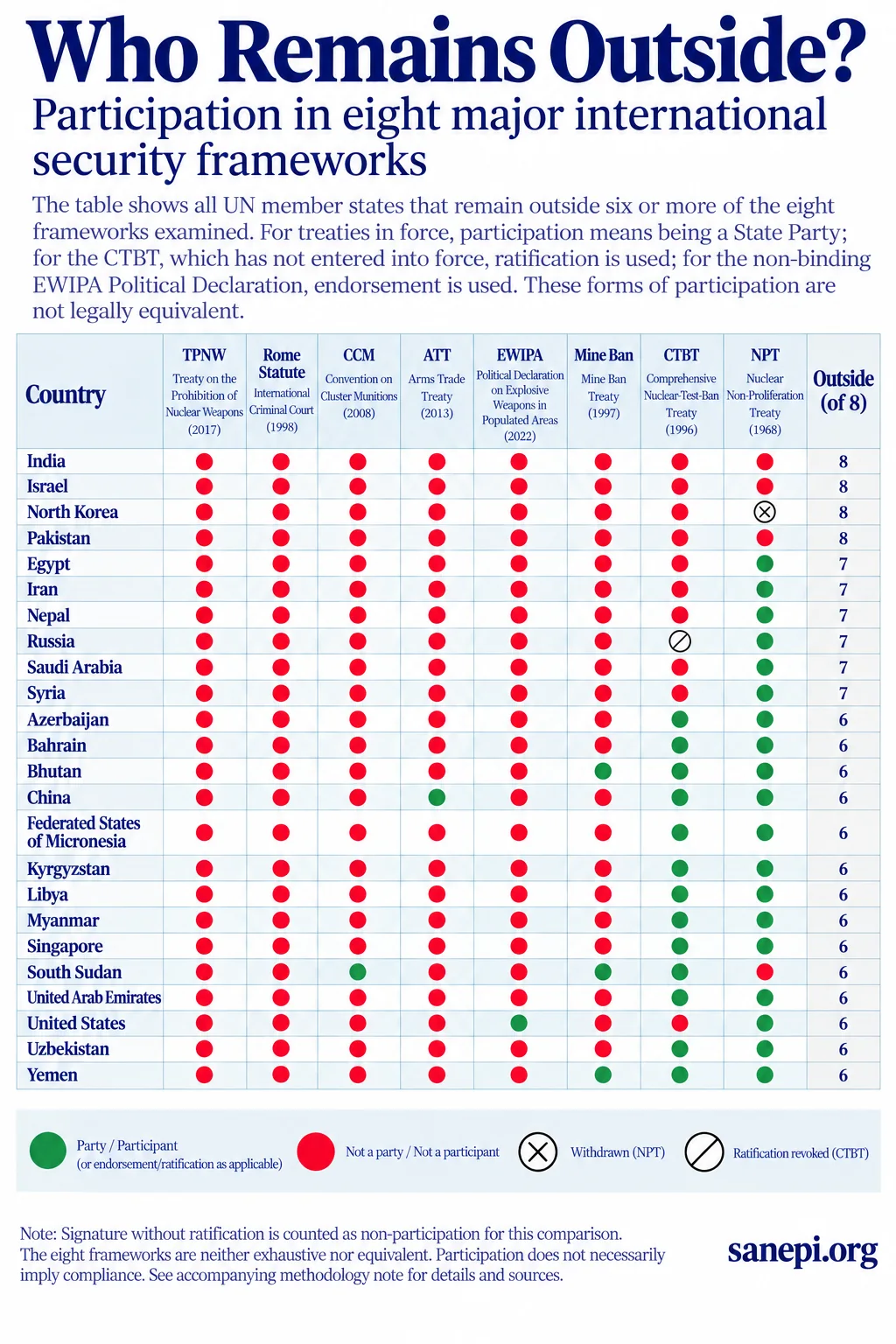
Across these eight frameworks, some states recur with striking frequency. The table below identifies those that remain outside six or more.
For the treaties already in force, participation means being a State Party. For the CTBT, which has not entered into force, ratification is used; for the non-binding EWIPA Political Declaration, endorsement is the corresponding measure. These forms of participation are not legally equivalent, and the comparison is simply a way of identifying recurrent non-participants across different regimes of restraint.
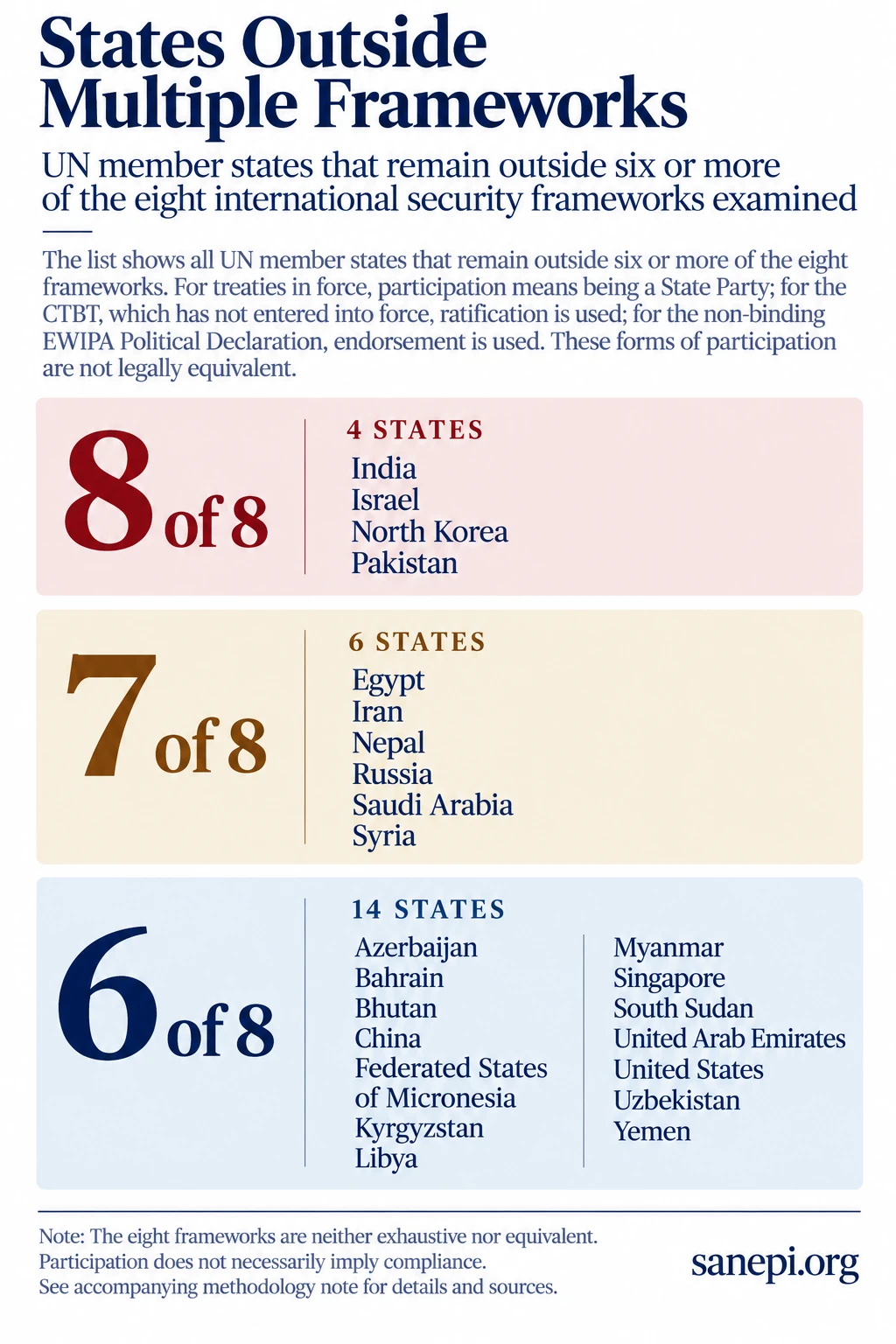
The list includes nuclear-armed states, permanent members of the UN Security Council, major military spenders and some of the world’s largest arms exporters. Their decisions have consequences far beyond their own borders.
The pattern also cuts across familiar geopolitical divisions. American allies and adversaries appear alongside one another. Democracies and authoritarian governments are represented. China participates in the NPT and ATT, while the United States participates in the NPT and has endorsed EWIPA. Both remain outside six of the eight frameworks, though their particular patterns of participation differ.
The point is not that these states are equivalent. Nor does participation in a treaty or other regime necessarily mean compliance with its rules or fulfilment of its objectives. States can formally accept international restraints and then disregard, circumvent or selectively apply them. Indeed, such failures by states already within these regimes are, alongside the persistent non-participation documented here, an important part of the broader erosion of international norms now underway.
But the comparison does establish something important: some of the states with the greatest capacity to employ military force are also among those that recur most frequently outside internationally negotiated restraints on weapons and warfare – and mechanisms for accountability.
That is a peculiar foundation for an international order supposedly built on rules.
Rules Being Rejected, and Reversed
The picture is becoming more troubling because non-participation is no longer the only concern. Some states that previously accepted restraints are now withdrawing from them.
Russia revoked its CTBT ratification in 2023. Lithuania withdrew from the Convention on Cluster Munitions in 2025. Estonia, Latvia and Lithuania withdrew from the Mine Ban Treaty effective December 2025, followed by Finland in January 2026 and Poland in February.
But the central question remains: what happens to humanitarian restraint when states conclude that restraint itself has become a security liability?
Anti-personnel mines were not prohibited because they lacked military utility. They were prohibited because their enduring and indiscriminate effects on civilians were judged unacceptable. The same basic logic underpins the prohibition of cluster munitions. Their military usefulness was never the decisive question. Their humanitarian consequences were.
If exceptional security circumstances become sufficient grounds for abandoning such prohibitions, the implications extend beyond any single weapon. Every future conflict will present its own claims of necessity, urgency and exceptional danger. The restraints most needed in war risk becoming the first to be discarded when war appears likely.
An Order Worth Defending
The current crisis of the rules-based international order has prompted renewed calls for middle-power leadership and for new forms of cooperation capable of preserving international institutions. Such efforts are welcome. But their credibility will depend on whether governments are prepared to defend international restraints when doing so carries political, economic or strategic costs.
Violations in Ukraine, Gaza, Iran and elsewhere cannot be assessed according to the identity of the perpetrator or the convenience of the political relationship. International institutions must be defended when they scrutinize friends as well as rivals. And humanitarian prohibitions cannot be treated as expendable whenever the security environment becomes more threatening.
The eight regimes examined here are imperfect. Some are not universal. Others face serious challenges of implementation and compliance. Yet collectively they reflect a fundamental premise: international order depends on states accepting meaningful constraints on their own conduct.
Do not proliferate nuclear weapons. Do not test them. Do not use anti-personnel mines or cluster munitions. Do not transfer weapons irrespective of their foreseeable consequences. Protect civilians from explosive weapons. Accept accountability for international crimes.
These are not abstract aspirations. They are practical restraints developed in response to the demonstrated consequences of war and unconstrained military power. A meaningful rules-based international order would constrain the strong as much as the weak and bind allies as well as adversaries.