
NATO Goes MAGA
by Cesar Jaramillo | July 8, 2025
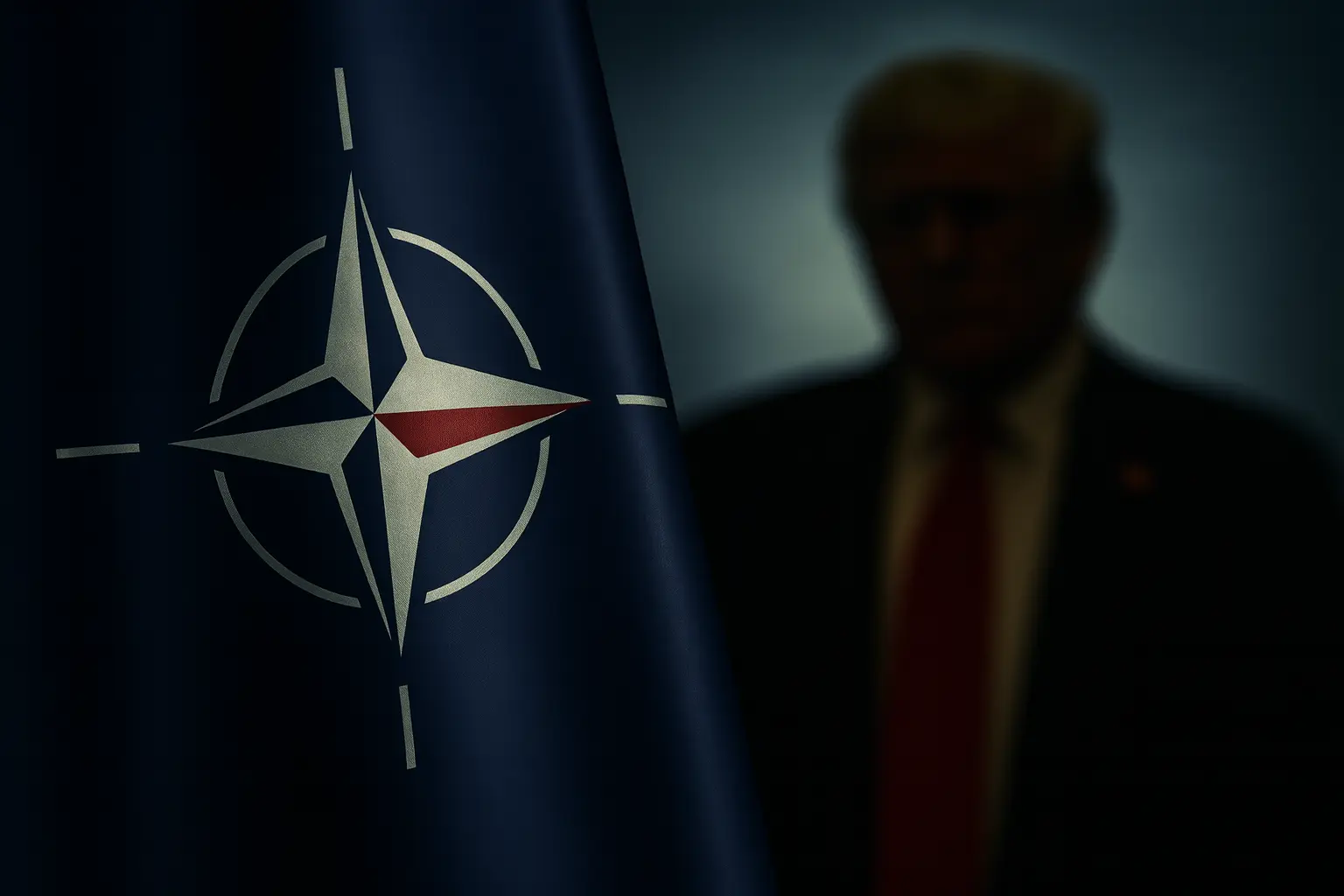
“No, not at all.”
– NATO Secretary-General Mark Rutte, asked by The New York Times if he worried that NATO’s defence buildup would trigger an arms race (July, 2025).
A Defining Moment
After sounding the alarm about Trump’s adversarial approach to longstanding allies, hostility toward multilateralism, threats of annexation, punitive tariffs, and a nakedly transactional take on diplomacy, NATO members appeared determined to assert greater independence. The consensus seemed clear: if the United States could no longer be relied upon as a steady and committed partner, then Europe would need to chart its own strategic course.
Disconcertingly, what emerged from this once-in-a-generation moment of reckoning was instead a full-throated embrace of Trump’s demands. Chief among them: a dangerous and arbitrary commitment to spend 5% of GDP on defence. “Peace through strength” was no longer just Trump’s mantra – it became NATO’s.
In a stunning display of political acquiescence and subordination, NATO chose to adopt Trump’s worldview wholesale.
Rather than pushing back against his coercive approach to international relations, the alliance is now validating it. Rather than questioning his narrow, militarized vision of security, it is enshrining it as NATO policy. Rather than defending multilateralism and international law, it is poised to echo Trump’s style, substance, and strategy.
Trump’s Man in NATO
This posture was on full, unapologetic display in a recent – and revealing – interview between NATO Secretary-General Mark Rutte and Lulu Garcia-Navarro of The New York Times. Rutte, once regarded as a pragmatic and experienced European statesman, seemed more eager to flatter Donald Trump than to articulate a coherent vision for a 32-member defence alliance in a moment of grave international uncertainty.
His remarks amounted to a rebranding of Trump’s most dangerous instincts as sound NATO policy. At times sounding indistinguishable from a White House spokesperson, the Secretary-General repeatedly echoed positions virtually identical to Trump’s own. He referred to Trump’s demands as rightful and long overdue – even adopting some of Trump’s rhetoric verbatim.
He called for applause, not alarm. “President Trump deserves all the praise,” he gushed, with no hint of irony. His tone was not one of caution or balance, but of deference.
Worse, Rutte presented Trump’s provocations not as a threat to alliance cohesion, but as the tough love NATO needed to finally “get serious” about defence. This inversion of reality – rewarding blackmail as bold leadership – is not only historically false, it sends a clear signal: belligerence is rewarded, and undermining allies is a valid path to influence.
Rutte’s selective concern for democratic norms was equally troubling. He was quick to question Spain’s democratic right to challenge the 5% target — one of the few voices of restraint within NATO — but silent on democratic backsliding in Hungary or Turkey, both of which remain protected under NATO’s umbrella.
When asked about Trump’s musings on annexing Canada or militarily seizing Greenland, he simply refused to comment. And not a single word offered — or question asked — about the provision of arms and political cover to Israel by the U.S. and other NATO members, despite Israel’s persistent violations of international law and international humanitarian law in Gaza.
The 5% Illusion
Nowhere is NATO’s strategic drift more glaring than in its embrace of Trump’s demand for members to spend 5% of GDP on defence by 2035 – an arbitrary, unaffordable, and unsubstantiated benchmark that will predictably undermine, rather than enhance, security and stability.
While the need for credible security strategies in an increasingly volatile world is not in question – particularly in the face of a global order undergoing undeniable and profound transformation – what is in question is whether inflated, imposed benchmarks like the 5% target will actually improve security outcomes. The historical record is hardly promising.
NATO’s challenge is not to spend indiscriminately, but to act deliberately in ways that strengthen collective defence without stoking new arms races or undermining the very norms it claims to uphold.
NATO already outspends its adversaries by a wide margin. Collectively, it accounts for more than half of global military spending, while Russia’s budget remains a fraction of that – even amid its war in Ukraine.
Suggesting that the alliance is falling behind, as Rutte does in his interview, simply because Russia – engaged in its largest military campaign since World War II – is temporarily producing more munitions is not serious strategic reasoning. It is a distortion designed to justify militarized policy choices.
In the end, Trump’s demands have now been rebranded as NATO orthodoxy. Rutte declares anything less than 5% “impossible,” and warns that failure to comply means Europe will “have to learn Russian.” Crude fearmongering.
He also argues that Russia’s public criticism of NATO’s buildup proves deterrence is working. By that logic, any protest becomes validation, and any escalation becomes evidence of wisdom. It’s circular, reckless, and dangerously unserious.
Missed Opportunity
This moment posed a profound choice for the transatlantic community. On one side stood a vision of international security rooted in diplomacy, shared responsibility, and the defence of a rules-based global order. On the other stood Trump’s model, methods, and worldview. The Secretary-General’s words made clear which path NATO is now following.
Rather than stand firm in defence of international norms, NATO is normalizing the very approach that undermines them. Of course, Rutte’s deference to Trump is not only cringe-worthy in tone – it is deeply consequential in substance.
He praised the illegal bombing of Iranian nuclear facilities as an “excellent job.” Never mind that this was the unprovoked use of force against a sovereign state, undertaken without UN authorization and outside any legitimate self-defence framework. To hear NATO’s Secretary-General endorse such a precedent — especially amid rising global tensions — is to witness the unraveling of the very norms that underpin global stability.
Throughout the interview, Rutte insists that NATO is strong, united, and indispensable. But beyond platitudes, there was no clarity about what the alliance actually stands for – what its core priorities are, what values bind its members, or what role it seeks to play in an increasingly unstable world.
On Ukraine, the dissonance was especially stark. Rutte inexplicably praised Trump’s interactions with Putin as a diplomatic “breakthrough.” This, despite Trump’s repeated efforts to undermine European support for Ukraine, sideline Zelenskyy, and slash U.S. aid. Rutte reframed this track record not as abandonment, but as “logical and fair” – a baffling characterization that must have raised eyebrows among his European – and Ukrainian – colleagues.
In its attempt to appease Trump, NATO is doing more than recalibrating its policy priorities. It is redefining its identity to mirror Trump’s: fear-driven, militarized, and transactional. What this moment required was a sober, principled articulation of NATO’s purpose in a volatile international environment. What it got instead was a coronation of its biggest critic.
And so, if anyone was wondering: NATO will not be a counterbalance to Trump’s worldview. It will be its willing instrument.
Cesar Jaramillo is Executive Director at SANE Policy Institute.