
Golden Dome and the Myth of Invulnerability
by Cesar Jaramillo | November 4, 2025
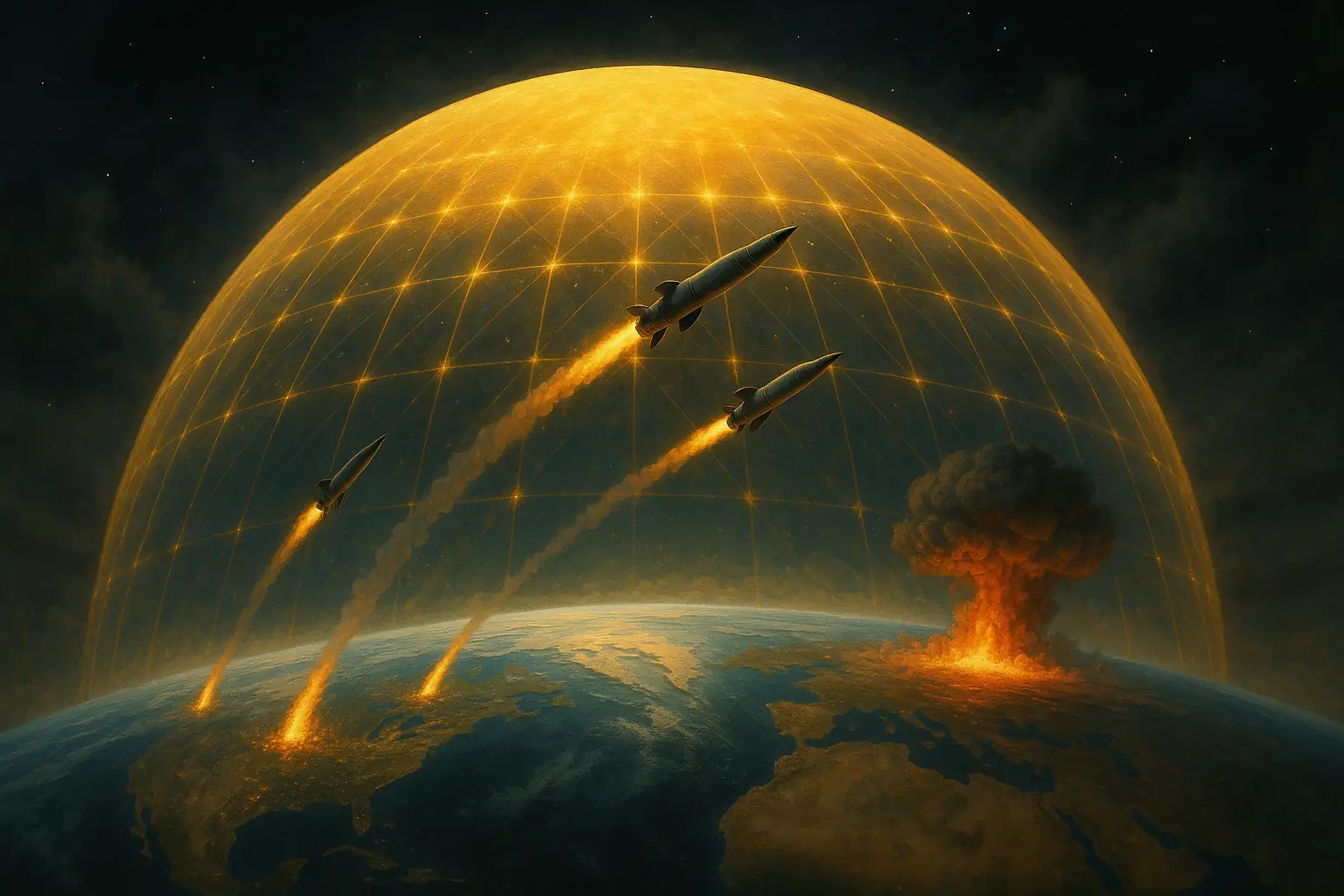
If Russian or Chinese nuclear missiles were ever raining down on U.S. and Canadian cities, no defensive shield could prevent catastrophe. By that point, deterrence would have failed, diplomacy would be irrelevant, and the international order itself would have unraveled. Such a moment would mark not a conventional military crisis but the makings of global thermonuclear war; a civilizational catastrophe by definition.
Global markets would collapse, communications would be severed, and the machinery of multilateral governance would be thrown into chaos. Countless unforeseen and unforeseeable vulnerabilities would surface across domains in ways impossible to predict or contain.
Yet it is precisely this fantasy scenario that underpins the United States’ proposed Golden Dome missile-defence initiative, a sweeping, space-based network of sensors and interceptors now being championed by the Trump administration. Framed as a leap toward continental protection, it is in fact a dangerous and enormously expensive attempt to achieve the illusion of invulnerability.
Put simply, the very conditions under which such a missile-defence system would be needed are those that would render it virtually meaningless.
Few ideas have proved as resilient, and as misguided, as the belief that technology can shield humanity from the consequences of nuclear war. From Ronald Reagan’s Star Wars program in the 1980s to a succession of similar schemes since, the promise has always been the same: that advanced interceptors and space-based sensors could neutralize nuclear threats and deliver safety through technological superiority.
Every iteration has collapsed under the weight of its own contradictions – scientifically unsound, unreliable in operation, destabilizing in strategy, and conceptually divorced from the nature of nuclear conflict itself. Golden Dome is the latest version of the same flawed logic, only with higher costs and greater risks.
Proponents may insist that Golden Dome represents an evolution of integrated air and missile defence rather than a resurrection of Star Wars. Yet its defining and most perilous feature endures: the strategic layer aimed at defending against long-range, nuclear-armed missiles. Whether designed to counter hypersonic, cruise, or intercontinental weapons, the underlying premise is unchanged: that technology can make nuclear war somehow manageable. It cannot.
And while some might argue that even limited protection could strengthen deterrence by denial, history shows otherwise. Such systems predictably provoke adversaries to build more and better missiles, eroding rather than enhancing stability.
Even if one overlooks Golden Dome’s staggering cost and technical shortcomings, its most basic premise collapses under scrutiny. Nuclear war is not a discrete contingency that can be managed with technology. It is a civilizational collapse.
What it can do, however, is justify astronomical spending on an enterprise that cannot deliver its promised outcomes. It also diverts attention from the measures that could actually prevent catastrophe: arms control, crisis-stability mechanisms, and diplomacy. A system that offers symbolic comfort but no real protection is not a safeguard but a distraction from the urgent work of nuclear-risk reduction.
If the world ever reached the point where major nuclear powers were launching strategic missiles, existential vulnerabilities would not be limited to those missiles. Nations would face the collapse of trade and finance, cyberattacks on infrastructure, and fallout that would render vast areas uninhabitable. The social, economic, and environmental toll would dwarf anything a “shield” could mitigate.
In that light, a seventy-billion-dollar space system appears absurd, a hyper-expensive attempt to treat one symptom of a terminal disease while ignoring its cause. The only meaningful defence in such a scenario is prevention: ensuring that nuclear use never occurs in the first place.
Because the strategic logic of missile defence is so weak, these programs tend to serve political rather than practical functions. They signal loyalty to Washington, feed domestic industrial and electoral interests, and reassure anxious publics.
Golden Dome is therefore not a response to a concrete threat so much as a performative ritual of reassurance. It allows governments to claim vigilance even when it contributes little to actual safety. This is the pernicious theatre of security.
At its core, missile defence embodies a philosophical contradiction. It imagines that technology can substitute for trust, diplomacy, and restraint; that stability can be engineered rather than cultivated politically. Yet the moment deterrence fails, no amount of engineering can compensate. Once the question is asked under which real-world conditions this would matter the entire edifice of this enterprise collapses.
For Canada, participation would not merely be a budgetary decision but a test of national principle. To join would be to endorse the fiction that nuclear risk can be managed through machinery rather than through law, dialogue, and restraint. It would also mark a sharp break from Canada’s long tradition of championing arms control and cooperative security.
Canada’s greatest contribution to continental and global stability lies not in technological dominance, but in diplomatic balance and the willingness to ask difficult questions when others are driven by fear or inertia. In a moment of resurgent great-power rivalry, genuine leadership would mean helping allies resist the false comfort of invulnerability and focusing instead on the conditions that make nuclear catastrophe thinkable in the first place.
True safety lies not in orbiting interceptors or space-based shields but in the patient, collective work of preventing the breakdown of order that would make such systems seem necessary in the first place. That is where Canadian influence is most valuable: not in preparing for the unmanageable, but in working to prevent it.
Cesar Jaramillo is Executive Director at SANE Policy Institute.