
Neither Here nor There:
Europe Adrift When it Matters
by Cesar Jaramillo | August 25, 2025
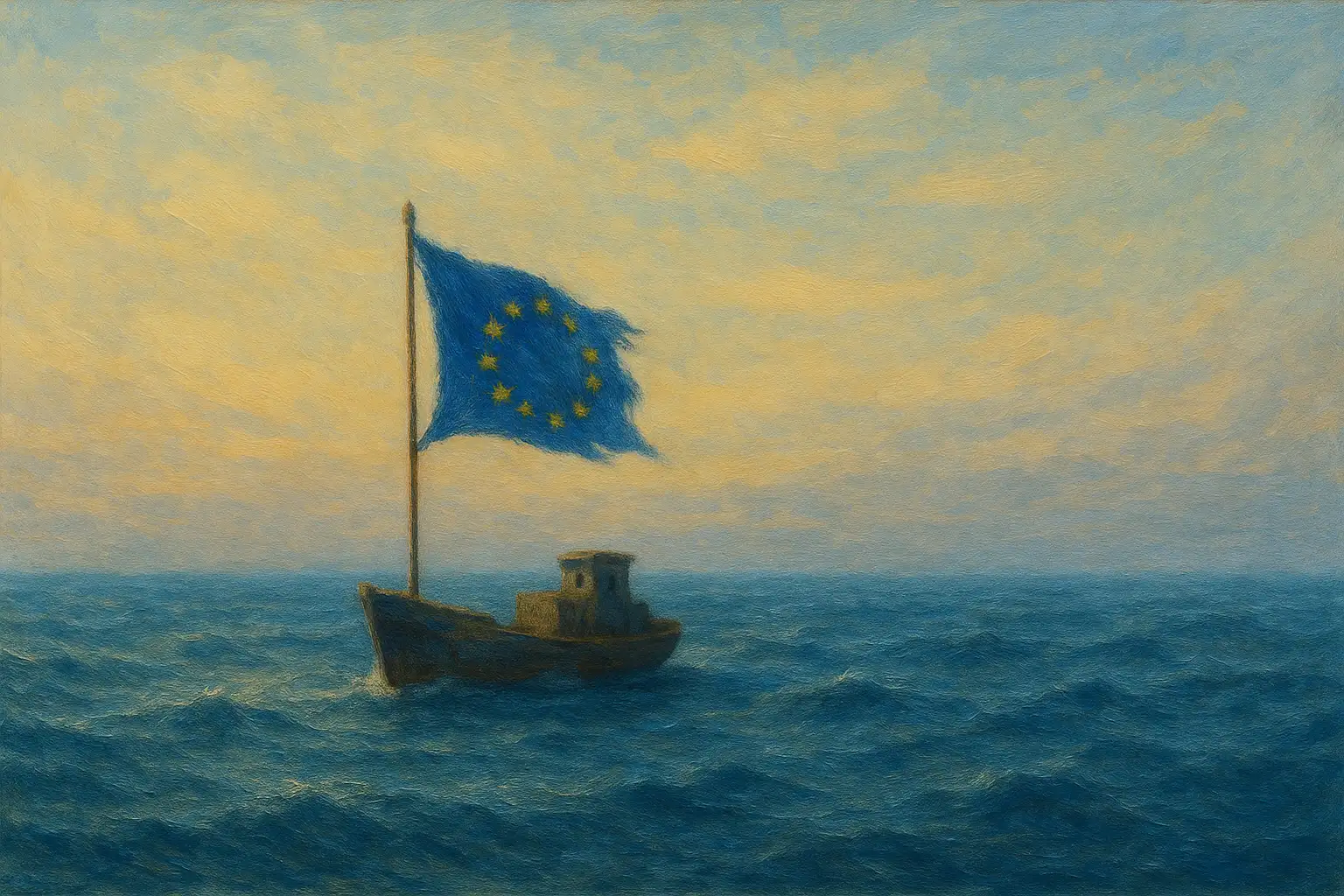
In June 2025 – after more than 55,000 Palestinians, including as many as 20,000 children, had been killed; after Gaza’s civilian infrastructure had been methodically reduced to rubble; after overwhelming evidence that Israel was blocking essential aid and using starvation as a weapon of war; after the bombing of refugee camps, hospitals, and places of worship; after targeted assassinations of humanitarian workers and journalists; after clear warnings from humanitarian agencies and legal experts of genocide; after more than one and a half years of a siege that violated every precept of international humanitarian law – the European Union, following much internal deliberation, concluded there were “indications” that Israel “would be” in breach of its human rights obligations. Indications. Would be.
The tentative phrasing, in the face of such overwhelming evidence, epitomized Europe’s timidity and unwillingness to confront a clear and direct assault on the rules-based order that it so often invokes. It is now scrambling to react to a widespread famine that was foreseeable for months, and expressing alarm about the expansion of Israel’s illegal settlements, which have been a defining feature of the occupation for decades.
The paralysis is not confined to Gaza. On Ukraine, Europe has allowed itself to become a spectator in a war raging in its own neighborhood – a war that has defined its foreign policy for years yet left it dependent on Washington for strategy, resources, and direction. On Iran, Europe’s ambivalence has been just as stark: having once claimed pride as custodian of a landmark arms-control deal, it now flirts with burying the very agreement it helped to craft.
Ongoing wars in Gaza and Ukraine, the collapse of nuclear diplomacy with Iran, and the steady erosion of the rules-based order have shaken the foundations of international security. This uniquely volatile context presented an opportunity for Europe to rise as a credible actor, to turn its vaunted principles into practice. The record has been hardly promising.
Gaza: Ambivalence in the Face of Atrocity
There is no disputing the scale of Gaza’s devastation. Tens of thousands killed, civilian infrastructure systematically destroyed, famine weaponized. These are not passing allegations at the margins of conflict but core violations of international law: sustained, deliberate, and visible to the entire world. For Europe, the test was not whether atrocities had occurred but whether it would enforce the very norms it so often invokes. But it didn’t rise to the occasion.
This shameful abdication will forever be a stain on European history. At precisely the moment when moral clarity and political resolve were required, the European Union chose hedging language and diplomatic caution. The disconnect between the scale of atrocity and the weakness of the European Union’s response has never been so wide – or so damning.
The contrast with Europe’s reaction to the war in Ukraine only underscored the double standards. Sanctions against Russia were imposed within days of its invasion, assets frozen within hours, and entire sectors of its economy cut off. In Gaza, after indiscriminate, disproportionate bombardment and growing famine, Europe could not muster more than a whisper about “indications.” The message to the world was clear: some lives and some norms matter more than others.
Timidity was compounded by complicity. Arms continued to flow from several European capitals. Some governments paused certain licenses but exempted key components, including for the Israeli F-35. Others maintained exports despite mounting evidence of war crimes. A few, such as Spain, took early action, canceling contracts and formally halting arms transfers. For most governments, action came only later, and only under intense domestic pressure as images of starvation and devastation circulated worldwide. Still, these exceptions cannot conceal the broader scandal: that any EU member would still be arming Israel.
Europe’s credibility as a defender of international norms lies in tatters. Leaders who rage about Russia’s war crimes in Ukraine refuse to apply the same standards when the perpetrator is Israel. The hypocrisy is undeniable, and it is noticed around the globe, from the Arab world but to the Global South, where Europe’s appeals to a “rules-based order” ring increasingly hollow.
Ukraine: From Stakeholder to Spectator
If Gaza demonstrates Europe’s moral cowardice, Ukraine exposes its strategic paralysis. The war that erupted in 2022 was shaping up to be Europe’s moment of unity and resolve. The EU imposed unprecedented sanctions, supplied arms, and opened its doors to millions of refugees.
Three years on, the conflict has ground into a stalemate, Europe and Ukraine have drifted to the margins, and the center of gravity has shifted to Washington and Moscow.
When the U.S. opened communications channels with Russia, the outlines of potential ceasefire terms were discussed in a room where the continent most affected by the war was absent. When European leaders rushed to Washington earlier this month for a White House summit with Donald Trump and Volodymyr Zelenskyy, the gathering was sold as a display of unity. In reality, it was an act of deference to a U.S. president who has derided Europe, belittled NATO, and openly embraced positions fundamentally at odds with Europe’s own.
Trump has opposed NATO membership for Ukraine, signaled acquiescence on Crimea, and cast himself as a partner to Vladimir Putin – the very man Europeans had branded a war criminal. Yet rather than resist, Europe lined up to thank Trump for supposedly “breaking the deadlock” by meeting with Putin.
But what deadlock was broken? Putin’s stance had not shifted. Even talks of postwar security guarantees are nothing more than the bare minimum any realistic settlement would entail anyway. To present this as a breakthrough is to fish for scraps in order to hand Trump a political win.
Ukraine remains existential for Europe. Zelenskyy has reminded Europeans that this is not just a war for Ukraine’s sovereignty but for the continent’s security order itself. If Ukraine falls, Europe’s credibility as a security actor collapses. And yet the continent with the most at stake has allowed itself to be reduced to a bystander – while praising an American president who ridicules it and who endorses the core positions of its adversary.
Iran: A Failed Custodianship
The nuclear deal with Iran was a high point in European security diplomacy. When the Joint Comprehensive Plan of Action was signed in 2015, the E3 — France, Germany, and the United Kingdom — together with the EU’s High Representative, worked alongside the United States (as well as Russia and China) to secure an agreement hailed as a triumph for diplomacy and a model of multilateral problem-solving. For Europe, it was tangible proof that it could move from declaratory principles to concrete diplomatic efforts that reduced the risk of war.
That moment proved fleeting. When the United States abandoned the deal in 2018 – in direct contravention of a binding UN Security Council resolution – the International Atomic Energy Agency was still confirming Iran’s full compliance. The E3 and the EU denounced Washington’s decision but ultimately bent to its pressure. Secondary sanctions drove corporations out, trade collapsed, and the promised economic relief evaporated.
Europe could have resisted. It had financial mechanisms, political leverage, and diplomatic capital at its disposal. What they lacked was the political will to use them. Instead of defending the agreement they had helped build, they watched it unravel. Iran, left without its promised dividends, predictably resumed nuclear activities the deal had once restrained.
Now, nearly a decade later, Europe resurfaces not as custodian but as executioner. Having failed to uphold their own commitments, the E3 now threaten to trigger the “snapback” mechanism, restoring the full weight of UN sanctions. The very powers that failed to salvage the JCPOA now threaten measures that would make a diplomatic resolution even less viable.
A Squandered Moment
The pattern is clear. In Gaza, Europe hesitates to condemn atrocities in plain sight, while keeping open the trade and arms flows that enable them. In Ukraine, it demands a seat at the table yet remains excluded from the talks that matter, then thanks a U.S. president who mocks Europe, ignores its stated positions, and embraces someone Europeans have called a war criminal. In Iran, where it once claimed diplomatic leadership, it has fallen short of its own responsibilities.
And the irony is stark: a moment of global upheaval could have been Europe’s chance to matter. It had the means, the history, and the moral standing to lead. Instead, it stalled, equivocated, and shrank. It not only let Gaza happen – it helped sustain it, with arms and political cover.
What could have been a revival of European leadership has become a warning of squandered opportunity. And this continent that failed to act when history called will be judged harshly when history records it.
Cesar Jaramillo is Executive Director at SANE Policy Institute.