
Dumb War Theory:
Anatomy of the U.S. Strategic Failure in Iran
by Cesar Jaramillo | August 5, 2026
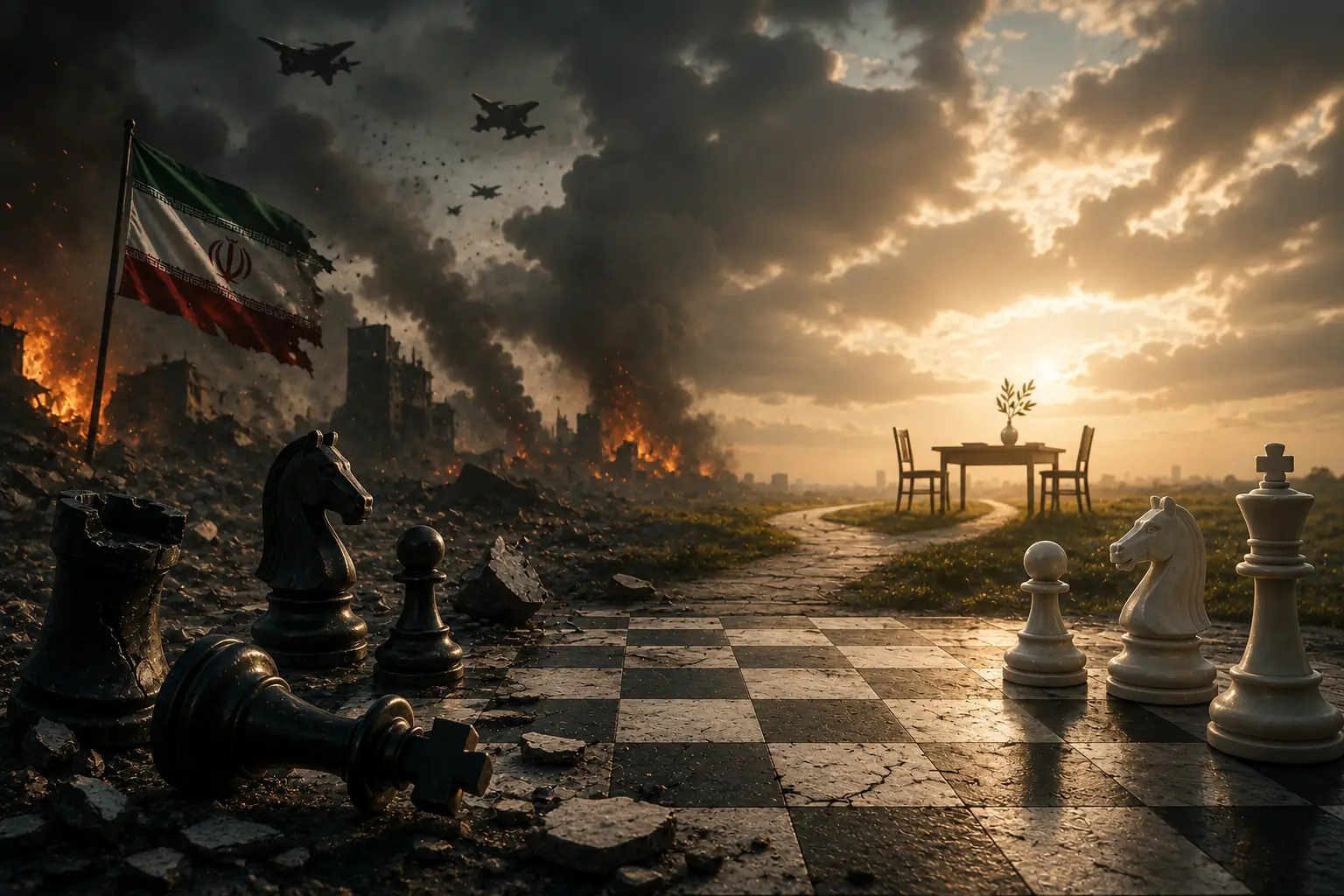
The Iran war quagmire did not begin with the illegal U.S. and Israeli airstrikes of February 2026, or even with the bombing by these same countries of IAEA-safeguarded nuclear facilities the previous June. It began much earlier, with a flawed narrative.
For decades, Iran has been portrayed as perpetually on the verge of acquiring nuclear weapons. “Months away,” “Weeks away,” “90 percent of the way there.” Enrichment has been repeatedly conflated with weaponization and technical capability with political intent. A legitimate security concern transformed into an imminent existential threat.
These distinctions have not only been poorly understood, but also deliberately blurred and politically manipulated. Over time, misinformation and disinformation narrowed the space for diplomacy and helped make military action appear not merely acceptable, but unavoidable.
Presented as necessary, decisive, and transformative, the military campaign was justified on the grounds that diplomacy had failed, Iran’s nuclear program had reached an intolerable stage, and only force could restore regional security and prevent a nuclear-armed Iran. Military action was portrayed not simply as a battlefield success but as a strategic turning point capable of achieving what years of negotiations had allegedly been unable to deliver.
Of course, the question is not whether the military campaign has inflicted significant damage. It plainly has; the United States and Israel have powerful militaries.
But judged against the achievement of clear policy objectives rather than against the destruction it caused, the war increasingly appears to represent something altogether different: an illegal, reckless, unnecessary, and ultimately counterproductive use of force that weakened rather than strengthened the very goals it claimed to advance.
Its strategic premise was supposedly straightforward: military force would produce a better result than diplomacy. It would deliver a better agreement, a weaker Iran, greater regional stability, and a durable solution to the nuclear issue.
Reality has been much different. The war inflicted immense damage, but the Iranian government did not capitulate. Instead, a renewed hardline leadership has emerged, reportedly much less willing to make concessions.
The political dispute has not disappeared. The region did not become more stable. The Strait of Hormuz, now weaponized, has become a source of global economic disruption. The conflict has depleted expensive weapons, imposed tens of billions of dollars in direct costs, and left Washington repeatedly threatening further escalation while still searching for a negotiated exit.
Thousands have died.
The Politics of Threat Inflation
The recent war did not emerge from a sudden crisis. It was the culmination of decades of political choices and threat inflation that transformed a manageable non-proliferation challenge into an apparent case for military action.
Of course, recognizing the role of threat inflation does not diminish the legitimacy of concerns about Iran’s nuclear activities. Iran concealed aspects of its nuclear program, accumulated significant quantities of enriched uranium, expanded its enrichment capabilities, restricted international monitoring, and raised genuine questions about the future direction of its program.
These developments warranted serious international concern, intrusive inspections, robust verification, sustained diplomatic engagement, and credible assurances that Iran would not develop nuclear weapons. But accurate policy begins with an accurate understanding of the problem. Increasingly, enrichment was treated as synonymous with weaponization. Technical capability was taken as evidence of political intent.
While Iran’s growing stockpiles and enrichment levels posed genuine proliferation concerns, U.S. intelligence assessments continued to distinguish technical capability from a political decision to build a nuclear weapon. In March 2025, just months before the June wave of strikes against Iranian nuclear facilities, the Director of National Intelligence stated that Iran was not building a nuclear weapon and that its Supreme Leader had not authorized one.
This disconnect between intelligence assessments and political rhetoric did not emerge in a political vacuum. Notably, Israeli Prime Minister Benjamin Netanyahu has for decades portrayed Iran as an imminent existential threat, opposed negotiated limits on its nuclear program, campaigned vigorously against the Joint Comprehensive Plan of Action (JCPOA), and urged successive U.S. administrations to abandon diplomacy in favour of maximum pressure.
Donald Trump was no passive recipient of this advocacy; he was a willing partner. During his first presidency, the United States unilaterally withdrew from the JCPOA, in contravention of the framework established by UN Security Council Resolution 2231. The long campaign against the JCPOA fundamentally reshaped the debate in Washington. By the time the recent war arrived, diplomacy had not simply failed; it had been systematically discredited as an acceptable policy option.
The JCPOA was never a perfect agreement, nor did it claim to be. Its purpose was not to transform the Iranian regime, resolve every regional dispute, end ballistic missile development, or address the full range of legitimate concerns surrounding Iranian foreign policy.
It was designed to achieve a far narrower objective: preventing Iran from acquiring nuclear weapons while avoiding war. On that measure, it established credible verification mechanisms, imposed meaningful restrictions on Iran’s nuclear activities, and significantly increased international confidence that any move toward weaponization would be detected.
In the end, this war was thus built not only on misunderstanding, but on the political use of misunderstanding. It did not become possible because diplomacy demonstrably failed. It became possible because diplomacy was progressively discredited as an acceptable policy option.
A Dumb War
The proposition that military force would produce a better political outcome than diplomacy in Iran does not withstand basic scrutiny. Military power can destroy facilities, eliminate commanders, and degrade military capabilities. The more important question is whether those tactical achievements translated into strategic success.
The central nuclear dispute remains unresolved despite repeated earlier claims that key nuclear facilities had been “obliterated.” The conflict has disrupted regional stability, heightened uncertainty in global energy markets, and imposed substantial military and economic costs on the United States and its allies, all without achieving a clearly defined political objective.
The irony is that the essential instruments of any durable settlement remain diplomatic rather than military, and they will bear a striking resemblance to the framework abandoned when the United States withdrew from the JCPOA. If the ultimate goal remains negotiated limits on Iran’s nuclear program, then the central question is no longer whether the war inflicted damage, but whether this recent military escalation produced a better political outcome than sustained diplomacy was already capable of delivering.
The consequences extend well beyond Iran itself. The war has further weakened confidence in international law by normalizing the use of force outside the framework established by the UN Charter. It has reinforced perceptions that legal principles are applied selectively rather than consistently, and weakened confidence in negotiated agreements by demonstrating that diplomatic commitments may be discarded in favour of military action.
Moreover, the war may have strengthened one of the most dangerous incentives in international politics: the desire to acquire nuclear weapons as a security guarantee. A non-nuclear state that accepts safeguards and inspections can still be attacked. Nuclear-armed states, by contrast, appear to enjoy a greater degree of strategic immunity – a perception that may prove strategically consequential.
Whether that perception is entirely accurate matters less than its potential to shape strategic calculations. If leaders in Tehran conclude that only a nuclear deterrent can guarantee regime survival, the war may ultimately have strengthened the very incentives toward proliferation that it claimed to eliminate.
Strategic Reckoning
After the abandonment of the JCPOA, years of maximum pressure, sanctions, sabotage, assassinations, and ultimately war, the path to a durable settlement still runs through negotiations. The essential components of any durable settlement remain remarkably familiar: robust verification, limits on Iran’s nuclear activities, reciprocal commitments, and phased sanctions relief. They resemble, in substance if not in precise form, the mechanisms contained in the agreement that was discarded.
Military force may have altered the balance of capabilities, destroyed infrastructure, eliminated scientists and commanders, and delayed elements of Iran’s nuclear program. But it did not eliminate the security perceptions that drive Iranian behaviour, substitute for sound strategy, or resolve the underlying political conflict.
The legal failure is significant. The United States and Israel used force against Iran without Security Council authorization and without a persuasive claim of self-defence against an actual or imminent armed attack.
Equally troubling was the international response. Faced with flagrant violations of the UN Charter and attacks on safeguarded nuclear facilities, much of the international community proved hesitant to impose meaningful political or diplomatic costs, reinforcing the perception that such conduct would be tolerated rather than deterred.
The tragedy of the recent war therefore lies not only in the destruction it caused, but in the strategic reasoning that produced it. A functioning diplomatic framework was abandoned in pursuit of an ill-defined “better deal.” Military action was presented as capable of solving problems that were, at their core, political.
The war was illegal because it lacked a persuasive and legitimate basis under international law. It was reckless because of the mounting regional, economic, nuclear, and humanitarian consequences. It was unnecessary because diplomacy had not failed; it had been abandoned. And it was counterproductive because, after immense destruction and heightened instability, the path to a durable settlement will likely lead back to many of the same diplomatic instruments that were available before the first bomb fell.
Military force cannot substitute for sound policy. And when the policy driving military action is itself built on manipulated narratives, flawed assumptions, and political miscalculations, strategic failure should surprise no one.
Cesar Jaramillo is Executive Director at SANE Policy Institute.