
Carney’s Davos Speech, Expired
by Cesar Jaramillo | March 3, 2026
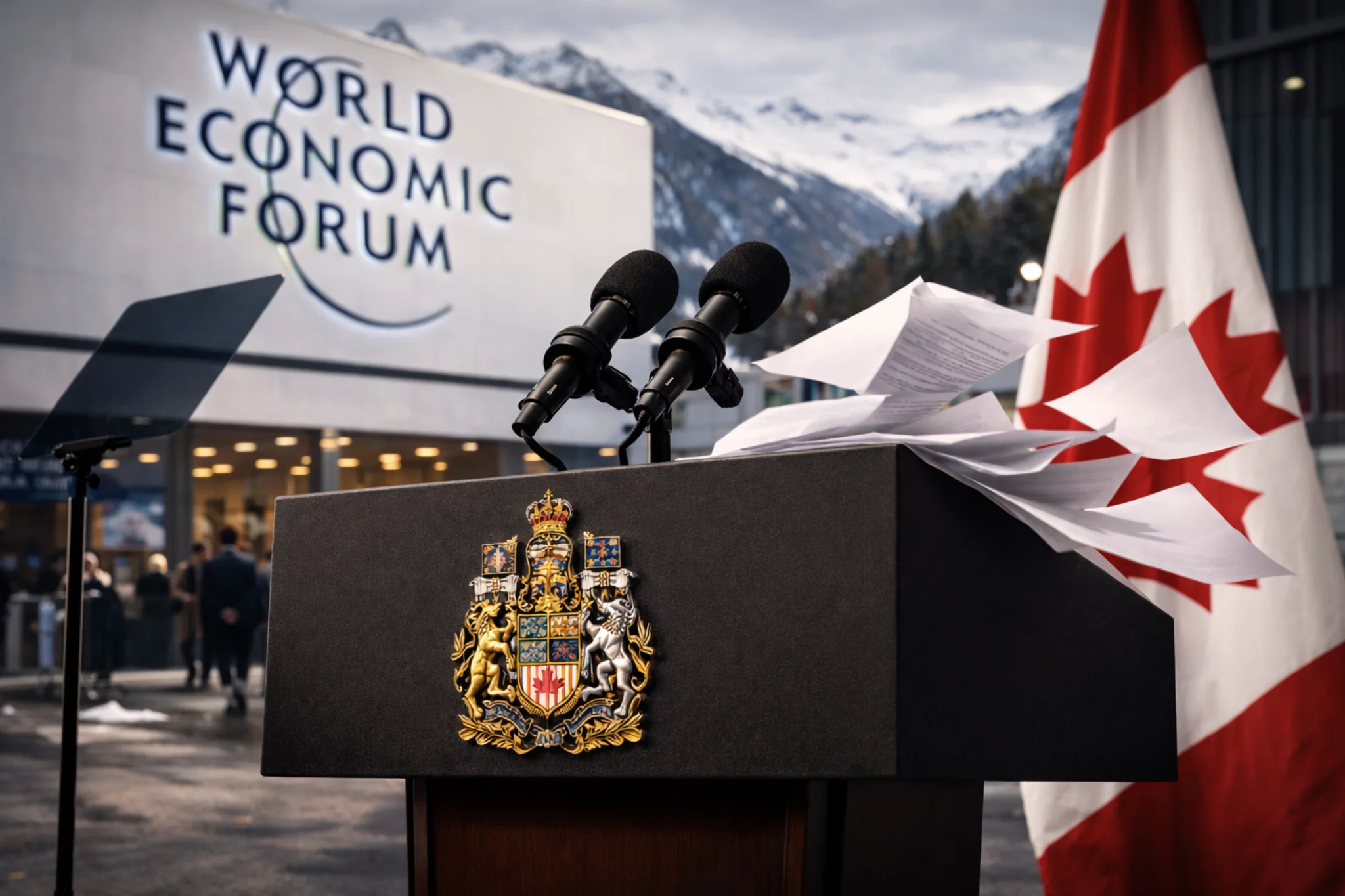
In his widely praised speech at the World Economic Forum in Davos, Canadian Prime Minister Mark Carney spoke persuasively of sovereignty, territorial integrity and “the prohibition of the use of force, except when consistent with the UN Charter.” He warned that “we shouldn’t allow the rise of hard power to blind us” to the enduring strength of legitimacy and rules. He insisted that consistency means “applying the same standards to allies and rivals.”
While the speech earned global nods and glowing summaries, many wondered how those principles would translate into practice. That question has met its first major test in the form of U.S. and Israeli strikes against Iran. And the polished words from the Prime Minister now ring increasingly hollow.
Canada has supported the U.S. and Israeli strikes against Iran that lacked authorization from the United Nations Security Council and were justified through shifting and unconvincing claims of urgency, absent clear evidence of an imminent armed attack. In doing so, Prime Minister Carney is entrenching the very dynamics he so eloquently criticized in Davos rather than charting a better course.
Following his expression of support for the attacks – described as offered “with regret” – the Prime Minister has urged de-escalation. The contradiction is hard to miss: endorsing military strikes with predictable escalatory consequences while simultaneously calling for restraint.
He has also suggested the strikes appear inconsistent with international law while stopping short of offering a clear judgment. Yet recognizing the illegality of the attacks does not strengthen the case for supporting them; it makes that support more indefensible. Instead, Canada’s position remains marked by ambiguity rather than the clarity this seminal moment for international security demands.
Public explanations for the attack have shifted between vague assertions of a growing threat, speculative timelines about nuclear capability and generalized warnings about regional instability. None meets the legal threshold required to invoke self-defence under Article 51 of the UN Charter. The Charter’s prohibition on the use of force is not a flexible guideline; it is the central restraint around which the modern international order is constructed.
At the time of the attacks, neither the International Atomic Energy Agency nor the U.S. intelligence community had publicly assessed that Iran was pursuing an active nuclear weapons program. For years, warnings that Iran was “days” or “weeks” from nuclear breakout have repeatedly come and gone. Inflation of urgency does not strengthen the case for force; it weakens confidence in the threat assessments used to justify it.
The New York Times has reported that pressure from Israeli Prime Minister Benjamin Netanyahu to abandon diplomacy and move toward war played a decisive role in President Trump’s decision. At the same time, amid a cascade of inconsistent justifications from administration officials, Secretary of State Marco Rubio advanced a novel theory: that the strikes were “preemptive” because Washington anticipated Israel’s attack and expected Iranian retaliation against U.S. interests.
Such reasoning stretches the concept of preemption beyond recognition and sets a troubling precedent.
This is not an argument in defence of Tehran’s conduct. Iran’s repression, regional interventions and unresolved questions about its nuclear program demand serious attention. But eroding the prohibition on the use of force will not strengthen global security; it will weaken it.
And while Tehran’s actions warrant scrutiny, it is equally important to ask who, precisely, Canada and its partners seem prepared to align themselves with.
Trump has openly threatened Canada, and his conduct toward this country and its allies can only objectively be characterized as hostile and adversarial. By any realistic assessment, volatility emanating from Washington poses a more immediate concern to Canadian sovereignty than Tehran does. This is the same leader who has belittled and demeaned European allies and undermined collective objectives in Ukraine.
Then there is Netanyahu, not merely the principal political driver of this war, but the leader of the only state in the region that possesses nuclear weapons and one of just four nuclear-armed states outside the Nuclear Non-Proliferation Treaty. His conduct of the war in Gaza has been marked by persistent and credible allegations of grave violations of international law and international humanitarian law.
Norm Erosion by Design
The problem extends beyond one Prime Minister. A growing tendency in Western commentary treats international law as conditional; binding on adversaries, optional for allies.
Like Canada, other Western governments are falling in line behind this unlawful and destabilizing use of force. Australia moved quickly to signal political support for the U.S. and Israeli strikes. NATO Secretary General Mark Rutte offered swift praise for the military action. In a display of rhetorical creativity, the United Kingdom justified making military bases available to the United States by describing military operations launched from them as “defensive” in nature. Portugal followed suit, making its air base in the Azores available for “defensive” operations as well.
A recent editorial in Canada’s largest and most influential newspaper, The Globe and Mail, dismissed concerns about violations of international law in the attacks against Iran as mere “niceties,” suggesting that Iran’s conduct forfeits the protection of legal constraint. The reasoning went well beyond minimizing legal concerns; it effectively endorsed regime change by force.
International law cannot be allowed to operate on a sliding, discretionary scale. If it did, it would cease to function as law. The UN Charter contains no exception permitting states to bomb governments they find odious. The moment a select, self-appointed few begin deciding which governments are entitled to its protections, the prohibition on the use of force becomes contingent on power and preference. That is a world middle powers like Canada cannot afford to normalize.
There is also an undeniable regional asymmetry. The only state in the Middle East to possess nuclear weapons is Israel, whose program remains outside the NPT and beyond international inspection. Sustainable regional security cannot rest indefinitely on permanent nuclear asymmetry combined with selective enforcement of non-proliferation norms. When legal standards appear unevenly applied, the credibility of the regime itself is weakened.
The silence surrounding the devastating strike on a girls’ school in Iran during the initial assault, which killed more than 150 people, most of them girls aged seven to twelve, is especially jarring. Expressions of outrage, sorrow or condemnation from Western leaders have been notably scarce. One can only imagine the reaction had such a tragedy unfolded elsewhere.
Selective Rules and Canada’s Test
Ottawa regularly affirms its commitment to sovereignty, territorial integrity and a rules-based international order. Those commitments are not abstract aspirations. They are operational tenets that must guide policy choices.
Canada does not possess the military weight of a great power. It relies on the integrity of international law to moderate power disparities and to ensure that force is constrained by collective authorization and demonstrable necessity. If the prohibition on the use of force is to retain meaning, it must apply consistently. Critically, if sovereignty and territorial integrity are to be more than rhetorical devices, they must constrain allies as well as rivals.
For four years, Canada and the West have spared no breath denouncing Russia’s illegal war of aggression. The irony is that they now appear prepared to support another such war.
Iran, of course, must not acquire nuclear weapons. The international community is entitled to expect and demand credible assurances that its program is exclusively peaceful. But non-proliferation cannot be defended by undermining the legal and diplomatic frameworks that make it possible.
“The world is as it is,” Prime Minister Carney observed in Davos. It certainly is. But acknowledging reality is not the same as endorsing it. Canada cannot claim to defend the international order while simultaneously contributing to its erosion. The Prime Minister should know better. The tragedy is that he probably does.
Cesar Jaramillo is Executive Director at SANE Policy Institute.