
2026 NPT: Expert Reactions
by SANE | May 29, 2026
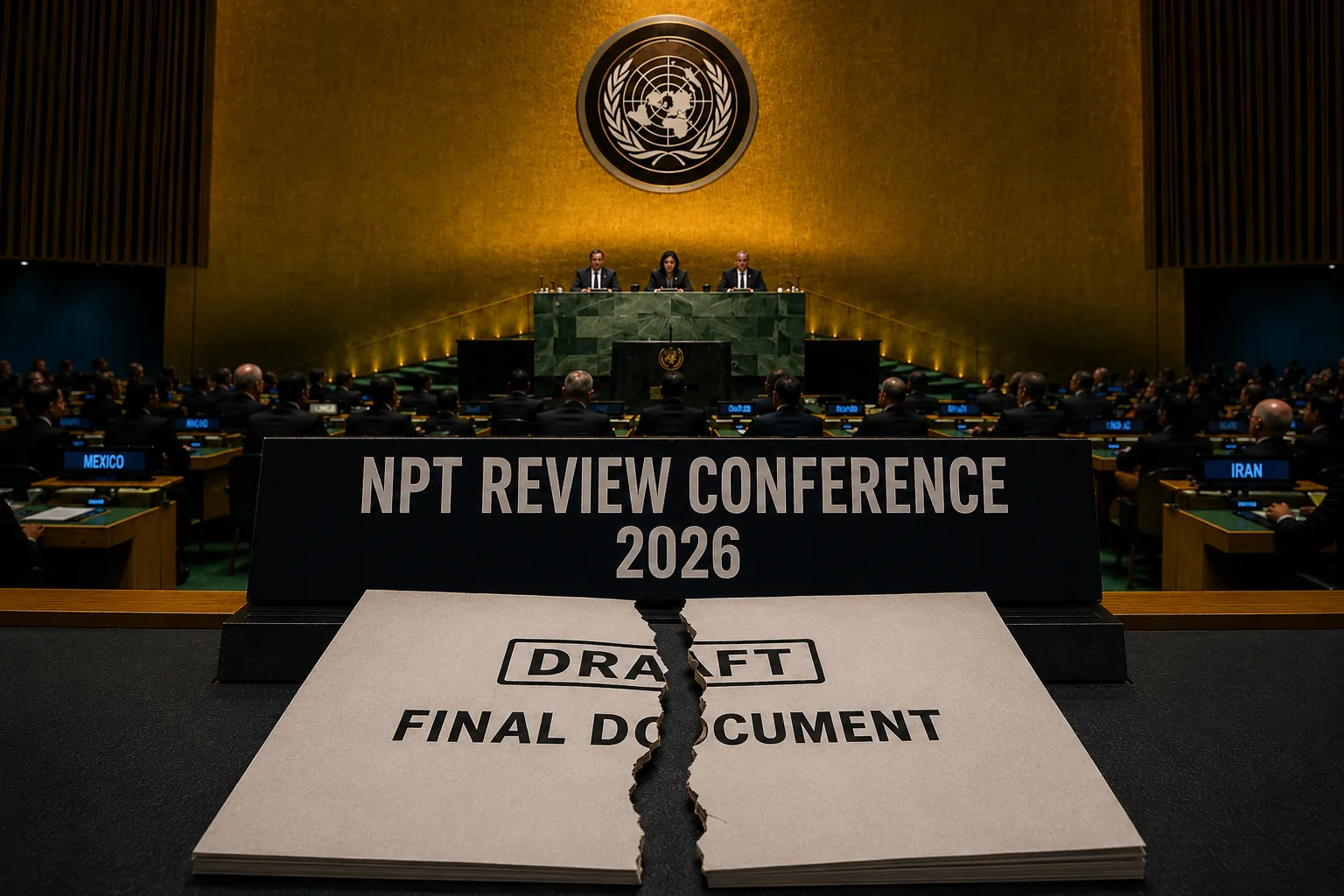
The 2026 Review Conference of the Treaty on the Non-Proliferation of Nuclear Weapons (NPT) concluded without agreement on a final document, marking the third consecutive Review Conference to fail to reach consensus.
Held against a backdrop of intensifying geopolitical tensions, renewed nuclear competition, accelerating modernization programs, and mounting distrust among major powers, the Conference revealed deep divisions over nuclear disarmament, non-proliferation, deterrence, and the future of the NPT regime. Fundamental disagreements permeated discussions across nearly every major agenda item.
Wars involving Ukraine and the Middle East, tensions surrounding Iran’s nuclear program, the collapse of key arms control frameworks, growing discussion of expanded nuclear-sharing arrangements, and renewed fears of nuclear escalation all shaped the diplomatic atmosphere in New York. These developments underscored the increasingly complex security environment in which the Treaty now operates.
At the same time, the Review Conference revealed widening divisions over the future direction of the non-proliferation and disarmament regime. Many non-nuclear-weapon states expressed deep frustration over what they regard as the persistent failure of nuclear-weapon states to fulfill their Article VI disarmament obligations. Others questioned whether the existing NPT framework remains capable of producing meaningful progress under current geopolitical conditions.
In the aftermath of the Conference, SANE Policy Institute asked a diverse group of experts from across the nuclear policy community to respond to ten questions on the state of the NPT, nuclear diplomacy, and the prospects for nuclear disarmament.
1
SANE: What is your main takeaway from the 2026 NPT Review Conference?
Ray Acheson
Executive Director, Reaching Critical Will
The nuclear-armed states were able to bully their way into determining the content of the draft outcome document, sending the signal that their geopolitical competitions with each other outweigh the legitimate security concerns of all other states, and the very survival of the planet. They sought to systematically remove all sense of urgency from nuclear disarmament, walk back concerns about the humanitarian consequences of any use of nuclear weapons, undermine their unequivocal undertaking for the total elimination of nuclear weapons, and not commit to any meaningful new measures on arms control, risk reduction, or transparency.
This shows we need to seek another path to nuclear abolition beyond relying on the “good faith” of the nuclear-armed states, which does not exist. The significance of the Treaty on the Prohibition of Nuclear Weapons is clear, but we need tangible actions by non-nuclear-armed states in terms of economic divestment, political pressure, and global outcry to prevent the resumption of nuclear testing and the use of nuclear weapons.
Jaqueline Cabasso
Executive Director, Western States Legal Foundation
That the nuclear-armed states have no intention of implementing their Article VI disarmament obligation for the foreseeable future and are thumbing their noses at the rest of the world as they openly engage in new arms racing, attack non-nuclear-weapon states parties in violation of international law, and issue nuclear threats.
Pia Devoto
Coordinator, Human Security in Latin America and the Caribbean Network (SEHLAC)
The NPT is under severe strain, the disarmament pillar in crisis. The end of New START, the wars in the Middle East, Russia-Ukraine and India-Pakistan, and no consensus about Iran led to the failure to have an outcome document for the third time in a row. But despite this, countries still see the NPT as necessary and the central framework for nuclear governance.
Ira Helfand
Past President, International Physicians for the Prevention of Nuclear War (IPPNW)
The non-nuclear states need to decide how they are going to step up the pressure on the nuclear-armed states given the utter failure of the nuclear-armed states to meet the Article VI obligations that are legally binding on the P5. At this point, the main function of the NPT is to whitewash this failure. Should the states in the TPNW consider withdrawing from the NPT since they have already pledged that they will not build nuclear weapons in the TPNW?
Manuel Herrera
Senior Policy Fellow & Programme Manager, Non-Proliferation and Disarmament, BASIC
I can draw several conclusions regarding this year’s Review Conference. First, as has been demonstrated previously, the NPT does not exist in a political vacuum. It is an instrument of public international law that continues to be influenced by the political dynamics of the international system. Second, the states parties to the Treaty remain unable to agree on acceptable minimum standards for continuing to implement the Treaty, even though the drafts for this year’s Conference emphasized precisely reaching a minimal, and I would almost say sterile, agreement regarding the content of the final document.
Third, and in relation to my previous point, I believe that if the states parties remain unable to reach agreements within the framework of this Treaty for its development and effective implementation across its three pillars (non-proliferation, disarmament, and peaceful uses), we should change our strategy or approach to addressing these issues, perhaps through regional, multilateral, or bilateral frameworks between certain nuclear and non-nuclear states.
Ivana Hughes
President, Nuclear Age Peace Foundation
I am deeply disappointed at the failure of the states parties to reach consensus and adopt an outcome document for the third review cycle in a row. To me, this unsuccessful conclusion to the conference is yet another consequence of the longstanding dereliction of the nuclear-weapon states to meet the Treaty’s disarmament obligations. The ongoing conflicts in the Middle East and Ukraine, rather than being seen as indicative of the urgency of disarmament, ended up as an excuse to avoid the responsibilities spelled out in Article VI, further eroding the Treaty’s foundation.
Rebecca Johnson
Executive Director, Acronym Institute for Disarmament Diplomacy
The 2026 NPT RevCon highlighted serious commitments by the majority of non-nuclear countries to keep the NPT alive, while the nuclear-armed states pushed their own nuclear status in ways that violated the core obligations of nonproliferation and disarmament. At a pivotal time of existential danger for all life on Earth, irresponsible nuclear-armed leaders have already undermined global security and many related treaties and international laws by expanding their nuclear arsenals, launching aggressive wars and wielding nuclear threats.
They brazenly justified violating Articles I, II and VI, while using Article IV as a marketing tool to proliferate weapon-usable technologies that are incapable of providing safe, clean, peace-supporting or climate-protecting energy resources. The takeaway at the end of four weeks was that today’s nuclear-dependent governments are willing to sacrifice the NPT and put humanity’s survival at risk as long as they can carry on enjoying the status, power and impunity that they have attached to the possession of nuclear WMD.
Daryl Kimball
Executive Director, Arms Control Association
The disputes on multiple issues and the failure to overcome all of them were not unexpected but were very disappointing. NPT states missed an important opportunity to formally reaffirm their support for the Treaty and its core principles, goals, and objectives at a time of increasing nuclear dangers. The month-long debate and the weak draft outcome document also revealed the disturbing reluctance of some nuclear-weapon states parties to meet their existing disarmament commitments and pursue new action steps to meet key disarmament goals and objectives.
Paul Meyer
Adjunct Professor of International Studies, Simon Fraser University; Former Canadian Ambassador for Disarmament
The chief takeaway from the Review Conference is of a Treaty that has been hollowed out of substance and is a shell of its former self. To use a hospital metaphor, the NPT has been moved out of the ICU and is now in the palliative care section.
The failure for the third time to produce an agreed outcome speaks to the egregious selfishness of some nuclear-weapon states, which readily sacrifice the interests of the vast majority of states parties in order to assert their national preferences. It demonstrates that NPT members have lost their common purpose and a modicum of restraint, pursuing ill-tempered disputes at the cost of draining the Treaty of its authority.
Götz Neuneck
Senior Research Fellow, Institute for Peace Research and Security Policy (IFSH), University of Hamburg
The nuclear-weapon states are no longer flexible and interested in disarmament progress. It reflects the poor situation of the world order and a maximum lack of political leadership to develop the key norms of the NPT. The majority of states are demanding disarmament and the prevention of nuclear use. The nuclear-weapon states are modernizing full steam ahead.
Joelien Pretorius
Professor in Political Studies, University of the Western Cape, South Africa
The NPT is not fit for purpose if the purpose is non-proliferation to make disarmament negotiations feasible and achieve a world without nuclear weapons. If the purpose is to keep nuclear weapons in the hands of only a few states for as long as possible and allow these states freedom of action in their international relations, then the NPT Review Conference makes complete sense. However, states that believe the NPT should pursue the first purpose will at some point lose interest in the charade of the NPT review conferences and decide to exit.
Tariq Rauf
Former Head of Verification and Security Policy, International Atomic Energy Agency (IAEA)
The Conference was doomed from the start, with the United States opposing Iran as one of the vice-presidents and sustained criticism regarding non-compliance, continuing pushback by NATO on nuclear sharing, pressure on China to engage in multilateral nuclear arms control and disarmament negotiations, and broader geopolitical tensions.
Tom Sauer
Professor in International Politics, University of Antwerp, Belgium
The third failure in a row. I predict many more failures if the states parties want to keep it alive, whatever that means.
Seth Shelden
General Counsel and United Nations Liaison, International Campaign to Abolish Nuclear Weapons (ICAN)
To me, the main recurring theme of the Conference was nuclear-armed states, together with a number of their allies, undermining law and norms relating to disarmament and non-proliferation, despite a majority of NPT member states working in good faith to advance those objectives. We did see a few promising developments throughout the negotiations, including language recognizing the calls for assistance from communities affected by nuclear weapons use and testing, language taking note of the TPNW, and the confidence of TPNW member states in advocating collectively for progress.
In the end, the pro-nuclear-weapon minority succeeded in manipulating a final draft that was abysmally weak and then tried, unsuccessfully, to pin the failure to adopt it on others.
Jennifer Simons
President, The Simons Foundation
Of course, it is disappointment because I am the eternal optimist and hoped that, because of the current extreme danger, common sense would prevail as it did in the 1960s when the NPT was negotiated. But at the Review Conference conclusion I was relieved that there was no document.
Alyn Ware
International Coordinator, Parliamentarians for Nuclear Non-Proliferation and Disarmament (PNND)
Nuclear weapons are fundamentally political weapons, the salience of which increases in times of international conflict and war. Unless the NPT Review Conferences can address international conflicts and war, they will fail to prevent proliferation or advance nuclear disarmament.
2
SANE: Does the failure to adopt a final document matter substantively, symbolically, or both?
Ray Acheson
Whether or not an outcome document is adopted at any given Review Conference, the Treaty remains in force, as do all of the past commitments and obligations agreed to at past Review Conferences. The nuclear-armed states watered down the draft outcome document from this Conference in a way that would have walked back from past language and commitments. So in that sense, it’s better to have 1995, 2000, and 2010 as the record, rather than something that walks those agreements back. What matters is that these commitments, and the legal obligations contained in the Treaty, are fully implemented. It’s the failure of the nuclear-armed states to eliminate their nuclear arsenals that is undermining the Treaty, not failing to adopt a piece of paper at a Conference.
Jaqueline Cabasso
It could be both, or neither. If the final document did not meaningfully recommit to and advance implementation of previously agreed commitments, it could paper over deep divisions among states parties and even roll back those previously agreed commitments.
Pia Devoto
Both, but even if the final document had been adopted, the real measure of success remains concrete action and demonstrable progress toward nuclear disarmament.
Ira Helfand
The failure to adopt a final document is only a symbol of how empty this Treaty has become. The real issue is the continued failure of the P5 to honor Article VI and the inadequate response of the rest of the Treaty signatories.
Manuel Herrera
Both. From a substantive standpoint, this represents yet another setback for the “successful” completion of another Treaty review cycle. And from a symbolic standpoint, this is the third Review Conference without a consensus-based outcome document, which underscores the Treaty’s poor state of health.
Ivana Hughes
I believe that both are true. This particular outcome can now be added to an already long list of missed opportunities to make the world safer by addressing and ultimately removing the existential threat to humanity, and possibly all life on the planet, posed by nuclear weapons.
Rebecca Johnson
The failure of NPT states parties to adopt a significant document covering nuclear-related issues cannot be dismissed as symbolic in 2026. This latest failure, driven mainly by irresponsible politicians in Russia and the USA and enabled by a few others, takes the NPT regime to breaking point.
It follows several substantive failures since 2005, when the Cheney-Bush war on Iraq went badly wrong and John Bolton blocked and then crashed the 2005 Review Conference after NPT states thought they had built on the extended and strengthened NPT outcome of 1995 with a significant final document that achieved consensus in 2000 on an important and substantive final document that enshrined 13 key steps on nuclear disarmament.
Daryl Kimball
The fact that divisions between a handful of NPT states have blocked a consensus final outcome document for the past three review cycles is a very serious problem. This Review Conference showed that rhetorical support for the NPT is strong, but the foundations of the NPT are cracking due to inaction, inattention, and intransigence on the part of the major powers.
Götz Neuneck
It matters both because it shows maximum disunity between nuclear-weapon states and non-nuclear-weapon states. The foundation of the NPT is now cracking visibly.
Joelien Pretorius
No, it was expected. If a final document was adopted, it would have been a surprise given the one-sidedness of implementation of the NPT’s obligations.
Tariq Rauf
Mainly symbolically.
Tom Sauer
Both.
Seth Shelden
Both. Following the failure, the NPT will continue to exist, and most states will continue to abide by it. Substantively, though, this failure may cut in two ways: on one hand, pro-nuclear-weapon states are demonstrating increasing disregard for the NPT, and in the short-to-medium term we may expect a few of them to further policies that violate or undermine the Treaty, whether increasing the role of nuclear weapons in security policies, hosting or even obtaining nuclear weapons, or resuming testing nuclear weapons. On the other hand, we see states with a genuine commitment to disarmament and non-proliferation looking more urgently for solutions, including by furthering commitments to the TPNW.
Jennifer Simons
It matters because the Treaty becomes weaker with no outcome document from each Review Conference.
Alyn Ware
The most important thing about NPT Review Conferences is that they provide a forum for countries to meet and discuss issues relating to nuclear non-proliferation and disarmament. From these, progress can be made regardless of whether or not a final document is adopted. In 2015, for example, no final document was adopted. But out of the discussions at the Review Conference emerged the UN General Assembly conference for a Middle East Zone free from nuclear weapons and other weapons of mass destruction, and the UN conference on negotiating a Treaty on the Prohibition of Nuclear Weapons.
3
SANE: Would you have preferred adoption of the last version of the final document?
Ray Acheson
See above answer.
Jaqueline Cabasso
No. When I look at the 2000 and 2010 final outcome documents from our current vantage point, it is almost unbelievable that consensus was reached in 2000 on thirteen “practical steps for the systematic and progressive efforts to implement Article VI” of the Treaty and in 2010 on a detailed 64-point Action Plan. At the time, I thought those commitments were weak. But the last version of the final document considered at the 2026 NPT Review Conference was like a hollowed-out ghost of those previous documents and, if adopted, I believe, would have constituted a setback.
Pia Devoto
No. By then it had been dramatically weakened and did not provide a blueprint for progress.
Manuel Herrera
Not necessarily. Overall, I have been disappointed by all the drafts of the final document that I have read throughout the Conference. However, I understand, and this is what some delegations have conveyed to me, that a document of this nature (short and concise) was necessary for the states parties to reach an agreement.
Ivana Hughes
If you had asked me ahead of the final session, I would have said that I saw the two possibilities, adoption of a weak document versus no adoption, as a toss-up. However, once President Viet announced in the General Assembly Hall that no consensus had been reached and that he was not even going to call a vote, my heart sank. I was truly and deeply disappointed, and remain so nearly a week later. So much energy, effort, and thought had been put into this Conference by President Viet, by so many excellent diplomats, and by civil society. And in the end, in some sense, we have nothing to show for it, not even the most basic recommitment to the Treaty’s principles.
Rebecca Johnson
I was sadly disappointed to lose factually relevant text on significant issues such as nuclear testing, the CTBT, attacks on nuclear facilities, the importance of complying with international humanitarian law etc., but I would have accepted the watered-down last version in order to signal that despite the dangerous behaviour of nuclear-armed governments the NPT still has an important role to fulfil. Having reported on all the NPT RevCons since 1990 I can say that the chairing by Ambassador Do Hung Viet was more constructive and effective than most, but that wasn’t enough to get a substantive outcome.
Daryl Kimball
Yes, even though the last version of the draft outcome document (Rev. 4) was weak and did not commit states to tangible action steps with any sense of urgency. If adopted, however, it still would have formally reaffirmed states parties’ support for the Treaty’s key principles on non-proliferation safeguards, disarmament diplomacy, the global ban on nuclear testing, nuclear-weapon-free zones, negative security assurances, and refraining from attacks on safeguarded nuclear facilities.
Götz Neuneck
Yes, because it would at least show some will for preserving the common foundation, making future development, including risk reduction, possible.
Joelien Pretorius
No.
Tariq Rauf
No. It was a major walk-back and dilution from the zero draft.
Tom Sauer
No, because it was the lowest common denominator that would only have prolonged the Treaty without substantially improving security in the world.
Seth Shelden
I wanted to see consensus and adoption of a final outcome document, but not that final outcome document. Earlier drafts of the outcome were far more promising, but the fourth and final revision reflected an abysmal regression on previously agreed commitments and norms relating to key issues such as the urgency of disarmament, the humanitarian consequences of any use of nuclear weapons, and the norms against any nuclear detonations.
Jennifer Simons
No! It would have been a terrible mistake with the language from the nuclear-weapon states intent on justifying the document as not supporting disarmament.
Alyn Ware
I would have preferred adoption of the first version of the final document. There were a lot of substantive measures supported in the first (zero) draft, such as the call for states to adopt no-first-use policies as a measure to reduce nuclear risks and pave the way for nuclear disarmament.
4
SANE: What issue deserved more attention than it received?
Ray Acheson
The unlawful attacks on Iran and its nuclear facilities deserved more attention. It was surreal how Russia’s illegal war against Ukraine and its occupation of and attacks against Ukrainian nuclear power plants were roundly condemned, but most countries were silent when it came to U.S.-Israeli attacks on Iran. At least the language on attacks against nuclear facilities was decent in the outcome document, but the lack of discussion on this was appalling.
And of course, nuclear disarmament, while it received a lot of attention from non-nuclear-armed states, received no attention from nuclear-armed states. They claim to be in compliance with Article VI while modernizing and building up their arsenals and threatening to resume nuclear testing. Discussion about a real plan for disarmament was sorely lacking at this Review Conference.
Jaqueline Cabasso
Without a doubt it was the U.S.-Israeli illegal war of aggression on Iran. It was remarkable to me that while many delegations condemned Russia’s ongoing war of aggression on Ukraine, almost none of them similarly condemned the U.S.-Israeli war of aggression on Iran, instead accusing Iran of violating its NPT obligations. Some of the Gulf states even condemned Iran’s strikes on their territories as “unprovoked,” without making reference to the U.S.-Israeli bombing of Iran that prompted those strikes.
Pia Devoto
The illegal attacks by nuclear-armed states against a non-nuclear-weapon state, including against safeguarded nuclear facilities.
Manuel Herrera
Frankly, I believe that, given the circumstances and context in which this Conference has taken place, the three pillars of the NPT have been well represented and addressed in the draft final documents. The problem has not been the omission or failure to include any particular issue or topic, but rather a matter of wording certain issues.
Ivana Hughes
The humanitarian consequences of nuclear weapons and the risk that the current arsenals of the nuclear-weapon states pose to our world continue to be largely ignored by those most responsible. The urgency of disarmament, precisely because the geopolitical conditions are so terrible, was not given a fair hearing in my opinion. I was also surprised that there was not more of a push for the Middle East Weapons of Mass Destruction Free Zone. I think that this is a very important issue for the future of the NPT.
Rebecca Johnson
Practical nuclear disarmament initiatives, including the TPNW, received far less attention than they deserved. By contrast, the 1950s ‘atoms for peace’ and ‘nuclear for deterrence’ justifications for nuclear proliferation activities were far more explicitly prevalent in 2026 than previous RevCons.
Daryl Kimball
The Conference itself and the existential issues debated there should have received more political, press, and public attention. The issue that states at the Conference should have focused on to a greater extent is the absence of implementation of Article VI, which requires good-faith negotiations to end the arms race and achieve disarmament, as well as ideas and proposals for jump-starting disarmament diplomacy.
One bright spot was that states parties insisted, despite opposition from the U.S. delegation, on including meaningful language in the draft outcome document in support of the 1996 Comprehensive Nuclear-Test-Ban Treaty (CTBT), against the resumption of nuclear testing by any state, and in support of the international monitoring and verification system of the Comprehensive Nuclear-Test-Ban Treaty Organization.
Götz Neuneck
The consequences of the use of nuclear weapons.
Joelien Pretorius
Implementing agreed steps towards disarmament.
Tom Sauer
Real nuclear disarmament. How do we get to zero? How do we delegitimize nuclear deterrence? How do we reduce current nuclear arsenals multilaterally and gradually, but with a clear timetable and deadlines?
Seth Shelden
I was disappointed that more states did not more directly criticize the rhetoric and policies, particularly from European NATO states, throughout this past NPT review cycle, including advocating for expanding nuclear-sharing arrangements and in some cases even acquiring nuclear weapons.
I was also shocked that more states did not condemn the recent outrageous examples of nuclear-armed states attacking non-nuclear-armed states, including peaceful nuclear facilities, purportedly in the name of non-proliferation.
Jennifer Simons
Iran. And it was like a paper tiger in a way because the JCPOA was not a bad agreement. It took attention away from the U.S. bombing of nuclear sites in Iran. It took attention away from the nuclear-weapon states and their violation of Article VI.
Alyn Ware
The strengthening of common security emerged in many of the civil society statements and side events as critical to making progress on nuclear non-proliferation and disarmament. This includes better use of the conflict-resolution and judicial mechanisms of the United Nations.
5
SANE: What development most worries you heading into the next review cycle?
Ray Acheson
The threats to use nuclear weapons and to resume nuclear testing are very concerning. The U.S. delegation really seemed to be trying to set up a pretext to justify the resumption of nuclear testing. The nuclear-armed states also pushed back on the idea that there is a global norm against such testing.
The threats of proliferation or more extended nuclear deterrence and nuclear-sharing arrangements are also really worrying. We are seeing more countries, particularly in Europe, claim that Russia’s aggressive actions against Ukraine mean they need nuclear weapons as deterrents, and since many of them no longer see the United States as a reliable partner in NATO, they are looking to acquire their own nuclear weapons or collaborate with France on new nuclear deterrence arrangements.
Jaqueline Cabasso
The possibility that one of the current wars, or a new conflict, could escalate to nuclear war, as international law is increasingly disregarded and degraded.
Pia Devoto
The expansion and modernization of arms, the normalization of nuclear deterrence, the announcements by European nuclear states such as France, military operations close to nuclear facilities in Ukraine and Iran, and the introduction of artificial intelligence.
Ira Helfand
Five of the nine nuclear-armed states have been engaged in active warfare over the last twelve months. The global security architecture that has existed since the end of the Cold War, imperfect as it was, is crumbling, and none of the leaders of the nuclear-armed states seems to appreciate the enormity and imminence of the nuclear threat we now face.
Manuel Herrera
In the context of the Treaty itself, I am concerned about two issues. First, that our framework of commitments to be met or implemented under the Treaty is outdated. I am referring to the 2010 Action Plan, which will be more than sixteen years old by the next review cycle. Second, many of the efforts made to improve transparency and accountability mechanisms throughout the review cycle that has just ended may now amount to nothing, as certain nuclear-weapon states that have committed to this agenda may simply decide that transparency is not worth the effort because it does not help achieve a final consensus outcome document.
Outside the framework of the Treaty, the most troubling development is that we have seen throughout the current and previous review cycles that two nuclear-weapon states have invaded and/or attacked a non-nuclear-weapon state, namely Russia-Ukraine and the United States-Iran, and we may see a third such instance in the next review cycle, namely China-Taiwan. Therefore, this could very well lead us in the coming years to a scenario of accelerated nuclear proliferation by certain countries, and I am not just thinking of Iran. Japan or South Korea are more likely candidates, which would further jeopardize the survival of the Treaty.
Ivana Hughes
The politicization of the discussions was an unwelcome development, and one that could impact the upcoming cycle even more negatively. The nuclear-weapon states need to have clear lines of communication on issues that pertain to the Treaty.
Rebecca Johnson
I am most worried that political threats to use nuclear weapons will turn into military actions that detonate nuclear weapons.
Daryl Kimball
There are several dangers looming ahead. Chief among them, in the absence of new agreements to limit the size and diversity of nuclear-armed states’ arsenals, we are headed for a dangerous, unconstrained global nuclear arms race.
If President Trump follows through on his threat to resume nuclear explosive testing in violation of the CTBT, and efforts in the United States and globally fail to stop him, it will lead to a chain reaction of nuclear detonations by other states that will blow a hole in the NPT regime.
In addition, the rapid integration of artificial intelligence into nuclear command, control, and communications systems will increase risk and lower the degree of human agency when the next nuclear crisis erupts.
Paul Meyer
As the nuclear-weapon states and their nuclear-dependent allies continue to espouse the security benefits of nuclear weapons, it will be no wonder that other states recalculate their security interests and pursue acquisition of nuclear arms.
Götz Neuneck
Countries leaving the NPT or ignoring its framework. Unrestrained multilateral arms racing and no risk reduction.
Joelien Pretorius
The money and diplomatic resources wasted on this ineffective Treaty.
Tariq Rauf
Confrontation and pettiness; NATO and EU obstructionism; and a hard-line U.S. approach.
Tom Sauer
That nuclear weapons will again be used, most likely as a result of inadvertent escalation in a conventional war, whether Russia-Ukraine, India-Pakistan, Israel-Iran, or another conflict. This is not a fictitious scenario. The Doomsday Clock stands closer to midnight than ever. Having followed this issue since the 1980s, I share this assessment.
Seth Shelden
At this moment, all nuclear-armed states are expanding and modernizing nuclear arsenals and, together with allies, increasing the role of nuclear deterrence in security policies.
To take one example of an egregious affront to the non-proliferation and disarmament regime, the newly adopted French policy to reduce transparency regarding its arsenal, possibly extend deterrence relationships, and advance a policy of forward deterrence and forward deployment seems likely to play out in extremely worrying ways over the next review cycle, including by provoking reactions from other states.
Jennifer Simons
Further backsliding by the nuclear-weapon states, which may treat the unadopted outcome document as the new normal and play down their previous commitments, notably those made in 2000 and 2010.
Alyn Ware
The rise of authoritarian leadership in Russia and the United States and their unconstrained acts of aggression against non-nuclear states.
6
SANE: Should Iran be able to enrich uranium strictly for peaceful uses under strict international verification?
Ray Acheson
There is no legal restriction on uranium enrichment for nuclear energy purposes as long as a country is in compliance with its IAEA Comprehensive Safeguards Agreement.
Jaqueline Cabasso
Yes, pursuant to the terms of Article IV.
Pia Devoto
As every NPT member state, Iran should have the right to have nuclear development, but it should accept inspections and not create an ambivalent dynamic in its nuclear development, which is embedded in the logic of deterrence as a perceived value for preventing external aggression.
Ira Helfand
There is no good reason for anyone to enrich uranium except on the most limited scale for research purposes and to produce medical isotopes.
Manuel Herrera
There is nothing in Article IV of the NPT that prevents a state party to the Treaty from possessing enrichment and reprocessing technologies, provided that it is in full compliance with its obligations under Articles II and III of the Treaty.
However, in the case of Iran, the Board of Governors and, subsequently, the UN Security Council have recognized that this state party is non-compliant with its Safeguards Agreement with the IAEA and is therefore in breach of Article III of the Treaty. Consequently, we could say that the conditions for Iran to possess the aforementioned technologies are not met. Until the Iranian issue is resolved at the IAEA, the conditions for Iran to enrich uranium under strict IAEA safeguards have not been met.
Ivana Hughes
Yes, of course.
Rebecca Johnson
This shouldn’t be just about Iran. The NPT’s Article IV turned into a proliferation driver. To be serious about preventing nuclear proliferation requires in depth discussions to agree on what constitutes a peaceful use of nuclear technologies and fissile material use and responsibilities. If strict restrictions are applied to Iran, as was done in the JCPOA, NPT states parties need to work out how to apply them across the board.
Daryl Kimball
The question is whether Iran should continue to do so and, if so, under what conditions and limits. Iran does not have a need, from an economic or energy standpoint, to enrich uranium, although it has the right to do so under Article IV of the NPT if it returns to compliance with its IAEA safeguards obligations. States in the Gulf region should explore the option of a nuclear fuel consortium that involves several states and reduces proliferation risks.
Paul Meyer
Iran has been the subject of aggression by two nuclear-armed states despite its non-nuclear-weapon-state status and the regime it has accepted for IAEA supervision of its exercise of Article IV rights. The U.S. sabotage of the JCPOA in 2018 constituted a poison pill for the NPT regime.
Götz Neuneck
Yes, because these are NPT obligations.
Joelien Pretorius
Yes. If other states can enrich uranium, so should Iran.
Tariq Rauf
Yes. The NPT permits it under a normal Comprehensive Safeguards Agreement. The JCPOA provided additional access.
Tom Sauer
Ideally not, but most observers agree that that activity is allowed under the NPT; so, yes.
Seth Shelden
For as long as other non-nuclear-weapon states are permitted to enrich uranium for peaceful uses in conformity with their NPT obligations and agreed-upon IAEA safeguard requirements, Iran should be allowed to do so as well.
Jennifer Simons
Yes. Definitely.
Alyn Ware
Why are you picking on Iran? Granted, its human rights record is atrocious. But it does not have nuclear weapons. It accepted stringent safeguards under the JCPOA. Yet two nuclear-armed states launched military attacks against it.
However, in answer to your question, there should be stringent constraints on uranium enrichment by any country, Iran included. A proposal on this was submitted by Parliamentarians for Nuclear Non-Proliferation and Disarmament (PNND) to the NPT.
7
SANE: What role can the TPNW play at this point in global nuclear diplomacy?
Ray Acheson
The TPNW has proved essential in showing that multilateral diplomacy for nuclear disarmament is still possible. It has elevated the humanitarian and environmental impacts of nuclear weapons and the perspectives of affected communities over power politics. It has provided a forum for states and others to evaluate the legitimate security interests that require the elimination of nuclear weapons. Its working groups and meetings have engaged in effective work on scientific evidence, disarmament verification, victim assistance, environmental remediation, and more.
The roadmap for nuclear abolition offered in the TPNW is a clear way forward. More countries should join the Treaty, work for its universalization and full implementation, and create the economic and political conditions that will help facilitate nuclear disarmament.
Jaqueline Cabasso
I see the main value of the TPNW as a tool for public education, especially in the nuclear-armed states. The TPNW demonstrates that most of the world’s countries, which have already renounced nuclear weapons as members of the NPT, many of them also members of nuclear-weapon-free zones, have unequivocally rejected nuclear weapons.
It also serves as a mechanism for non-nuclear-weapon states to consolidate their voices. However, the TPNW cannot realize nuclear disarmament without the participation of any of the states possessing nuclear weapons, and unfortunately all of the nuclear-armed states parties to the NPT adamantly rejected the TPNW during the recent Review Conference.
Pia Devoto
The TPNW will continue to serve as both a rallying point and a forum to catalyze action from non-nuclear-weapon states.
Ira Helfand
That is the great question. Will the TPNW Review Conference serve to catalyze a global demand for nuclear disarmament?
Manuel Herrera
This year will see the first Review Conference of the TPNW, and it will serve as a litmus test to gauge the health of both treaties, the NPT and the TPNW. I believe that a successful TPNW Conference, although it remains to be seen how the states parties define “successful,” as there is still no consensus on the matter, could force certain NPT states parties, primarily the nuclear-weapon states and non-nuclear-weapon states aligned in alliances with nuclear-weapon states, to revitalize the Treaty’s review process.
Ivana Hughes
The TPNW needs to continue to put pressure on the nuclear-weapon states and their allies, both externally, from the international community by increasing the number of states that join the Treaty, and internally, by making the general public aware of what is at stake in a world awash with nuclear weapons and of the solution, which is the TPNW.
Rebecca Johnson
The TPNW entered into international legal force in 2021 and will hold its first Review Conference at UN HQ in November-December 2026. Despite efforts by a few nuclear-armed states to erase these salient facts from NPT documents, the TPNW is clearly an essential part of the nonproliferation regime. It frames the core obligations essential for compliance with all of the NPT’s key articles.
By working together to take the TPNW forward governments, scientists, diplomats and civil society will continue to play important roles in global nuclear diplomacy of all kinds, including through developing disarmament verification mechanisms and regionally relevant diplomacy to stigmatise, marginalise and eliminate nuclear weapons.
Daryl Kimball
The TPNW is a major contribution to the global disarmament and non-proliferation system that reinforces the NPT and challenges the concept of nuclear deterrence.
But given that nuclear-armed states and their allies are outside the TPNW framework, it is having no direct impact on the potential for a global nuclear arms buildup, nor is it playing a practical role in preserving the global norm against nuclear testing. TPNW states can and should continue to develop the TPNW, but must also act more assertively and in coordination to press the nuclear-armed states through the NPT process and elsewhere to engage in nuclear disarmament negotiations, whether bilateral or multilateral, and to move closer to a world without nuclear weapons.
Paul Meyer
The TPNW offers an alternative way for NPT members to fulfill their Article VI obligations, but if it is to progress, it will need a change of attitude on the part of the nuclear-weapon states and their nuclear-dependent allies.
Götz Neuneck
It can establish a platform to discuss, elaborate, and publish ideas and steps to mitigate the growing divide between nuclear-weapon states, non-nuclear-weapon states, and umbrella states.
Joelien Pretorius
The TPNW is a diplomatic home for non-nuclear-weapon states that have lost confidence in the NPT and want to leave the NPT treaty regime, but want to continue to be a part of the non-proliferation and disarmament regime.
Tariq Rauf
Continue to further delegitimize nuclear weapons and deterrence.
Tom Sauer
The TPNW is revolutionary. It is a very useful tool to clarify the legal issues around nuclear weapons. Politically, it energized the Global South and the peace movement worldwide.
If the TPNW wants to have real impact, however, all Global South countries that negotiated the Treaty in 2017, or that are party to a nuclear-weapon-free zone, should become party to the TPNW in the foreseeable future. That should, in principle, not be that difficult.
The next step is that at least one nuclear ally, likely with a left-wing government, signs up, making it easier for other allies to do so. If not, the TPNW remains basically an instrument of “the oppressed.” Only if the nuclear-armed states are isolated may they feel the pressure. If the TPNW cannot make inroads into the nuclear club through norm-building, socialization, and stigmatization, it will become, at a certain point, another NPT in the sense of being a treaty that no longer has much added value.
Seth Shelden
At minimum, the TPNW enables its states parties and signatories, now a majority of the world’s countries, to advance a collective position on the urgency of nuclear disarmament, to adopt decisions that advance a framework for total elimination, and to take forward a process to address the needs of communities affected by nuclear weapons use and testing.
At maximum, the TPNW offers a pathway for nuclear-armed states to disarm once they agree that disarmament is a more sustainable way to protect their citizens.
At this point, in 2026, a year that began with clear violations of international norms and law, such as attacks in Venezuela and later Iran, and that has continued with failures of legal infrastructure, such as the demise of New START and the collapse of the Eleventh NPT Review Conference, we can at least help close the year with a successful first Review Conference of the TPNW. Success there would point toward hope for multilateralism and international law, even in this moment.
Jennifer Simons
It is essential that there is urgent forward momentum to bring more states into the Treaty. This should be the goal of the NGO movement, especially in umbrella and allied states.
Alyn Ware
Nothing. The TPNW leaders squandered any chance of playing an influential role with nuclear-armed and allied states when they stipulated that there are no security roles for nuclear weapons and when they rejected the proposals of the Netherlands in the 2017 negotiations to establish the TPNW.
The Netherlands participated in the negotiations in good faith, with the full support of Foreign Minister Bert Koenders, a member of PNND. The resulting Treaty has been rejected by all of the nuclear-allied states in addition to all of the nuclear-armed states. They argue, correctly, that it does not address the issues that would be required to move nuclear-armed and allied states to relinquish nuclear deterrence and abolish nuclear weapons.
These issues are considered and resolved in the Nuclear Weapons Convention and common security frameworks for nuclear disarmament.
8
SANE: Should U.S.-Russia strategic dialogue resume independently of China, or must China be included from the outset?
Ray Acheson
Arms control should resume immediately in any configuration. China should engage, but the United States and Russia should not wait for it to make commitments of their own. They still have the largest arsenals and should apply the limits of New START and agree to further disarmament measures, which China could be brought into as a partner, rather than persisting in the current standoff where there are no agreed limits by any state.
Jaqueline Cabasso
Any strategic dialogue discussions among any nuclear-armed states, in any order, should be welcomed, and others should be encouraged to join in.
Pia Devoto
The United States and Russia still need bilateral discussion at the table as they possess 85–90 percent of the world’s nuclear arsenal, although China’s rapid arsenal expansion and missile and space capabilities require the development of integrated conversations in the near future.
Ira Helfand
China needs to be part of the process, with the understanding that it is hypocritical to demand that it reduce its nuclear weapons until the United States and Russia reduce to the level of the current Chinese arsenal. But a Chinese refusal to join negotiations now must not be an excuse for inaction by the United States and Russia.
Manuel Herrera
I believe it would be beneficial for strategic dialogue between the United States and Russia to resume, regardless of whether or not China agrees to join those discussions.
Ivana Hughes
The United States and Russia possess some 87 percent of the world’s nuclear arsenal. The ball is clearly in their court. China is still far off in terms of the size of its arsenal, despite the recent, and unwelcome, increases in the number of its warheads.
I advocate for U.S.-Russia dialogue and agreement on reductions first, and bringing China in when the former two have come down significantly from the 5,000-plus warheads in each of their arsenals.
Rebecca Johnson
The US and Russia need to restart and bring to fruition bilateral engagement to repair the damage the Trump and Putin leaderships have caused to all aspects of international security and move beyond their mutual destruction of nuclear arms control treaties and agreements, pursue deep cuts in nuclear arsenals while inviting China to engage more fully.
China cannot be compelled to engage in US-Russian dialogue on arms control, and three-body relations are notoriously difficult to manage constructively. That said, China sets high value on maintaining security and economic relations with many TPNW states parties, who should engage Beijing in constructive nuclear dialogues on nuclear nonproliferation, security and regional ways forward.
Daryl Kimball
All five NPT nuclear-armed states have Article VI responsibilities. We have advocated that there is no reason to delay U.S.-Russian follow-on negotiations on a new nuclear arms control framework to supersede New START while the United States and China engage in nuclear risk reduction and arms control talks, and/or the NPT’s Nuclear Five somehow engage in a five-sided negotiation on disarmament.
Paul Meyer
An energized security dialogue should be an imperative for the nuclear-weapon states. The consultative framework already exists; they just have to own up to their responsibilities and ensure that it produces tangible results.
Götz Neuneck
The strategic dialogue between Russia and the United States must continue. All five nuclear-weapon states can provide their own framework to discuss future doctrines.
Joelien Pretorius
It is time that all nuclear-armed states negotiate disarmament in good faith. Piecemeal negotiations, whether called strategic dialogue or anything else, have not worked. The correct forum for this is multilateral, the Conference on Disarmament. Alternatively, nuclear-armed states can unilaterally join the TPNW.
Tariq Rauf
The United States and Russia can do one more round of START.
Tom Sauer
Ideally, all nuclear-armed states should start multilateral negotiations for nuclear disarmament, perhaps in the form of a Nuclear Weapons Convention, like the Chemical Weapons Convention and Biological Weapons Convention, as required by Article VI of the NPT.
In practice, it is easier to go step by step. That means that the United States and Russia first build down to the levels of China. At that point, the United Kingdom and France also need to join the negotiations. Later on, the non-NPT nuclear-armed states should join as well.
Seth Shelden
Russia and the United States continue to have every opportunity to lead the world toward safer policies. With or without the participation of other states, the two states could, for example, agree to continue to abide by the quantitative limitations of the expired New START Treaty, cancel disastrous plans to expand arsenals or test nuclear weapons, or reduce the role of nuclear weapons in security policies in myriad ways.
Of course, Russia and the United States may seek to engage China on these matters, and would necessarily consider China in adopting any policies. But if the two countries with the largest nuclear arsenals were to sincerely advance disarmament commitments bilaterally or unilaterally, it would be easier for them, and the global community, to push China to advance disarmament objectives as well.
Or, to make the converse argument, failure by Russia or the United States to demonstrate a commitment to its own disarmament is a certain way to fail to court China on strategic nuclear dialogue as well.
Jennifer Simons
Russia and the United States should engage in strategic dialogue and agree to cut their weapons to the numbers China holds, and then include China.
Alyn Ware
There should be a combination of bilateral, trilateral, and plurilateral dialogues.
9
SANE: What one measure could most advance nuclear disarmament over the next five years?
Ray Acheson
The nuclear-armed states must start disarming. They are legally obligated to do so. We have the tools for verification. The geostrategic games they are playing are not leading to progress; they are leading to more nuclear weapons. This must be reversed through urgent action. They could decide today to start drawing down their deployed forces, dismantling their arsenals, and ending their doctrines of deterrence and destruction.
Jaqueline Cabasso
New leadership in the nuclear-armed states.
Pia Devoto
Determined political leadership and actions from the United States and Russia.
Ira Helfand
If the leader of one of the great powers, Russia, China, or the United States, stated clearly that the continued existence of nuclear weapons poses an unacceptable threat to all humanity, and launched a serious effort to actively engage counterparts in achieving nuclear abolition.
Manuel Herrera
You raise a complex issue since, as we have seen in the review cycle that has just concluded, matters of disarmament, or efforts to emphasize the mandatory nature of nuclear disarmament under Article VI of the Treaty, have been deliberately sidelined, even by the states parties most proactive on this matter, in an effort to facilitate the adoption of a consensus outcome document, which ultimately was not achieved.
This could prompt a reactive response from the states parties I have referred to, leading to a revitalization of the nuclear disarmament agenda in other forums or through other means.
Ivana Hughes
I think we sorely lack public awareness of even the most basic science, history, and policy issues when it comes to nuclear weapons, followed by genuine and widespread engagement. This seems to be a prerequisite for nuclear-weapon-state governments to actually move in the direction of disarmament.
Rebecca Johnson
Focusing on one measure would undoubtedly lead to deadlock, thereby failing to advance across a range of nonproliferation and disarmament imperatives.
Three measures would make a big difference: 1) Factual recognition of the TPNW as an essential and constructive part of the NPT-based nonproliferation regime; 2) Strengthening and enforcing widely embedded norms (if not explicit prohibitions under the NPT itself) against nuclear detonations through non-use and non-testing, and carrying that forward through CTBT and its verification regime; 3) Replace rhetoric about the FMCT with serious multilateral and perhaps regional talks that set limits on what fissile material production limits would be required to rule out military purposes, increase security and reduce proliferation risks and dangers.
Daryl Kimball
Before we can realistically advance nuclear disarmament, we must halt the further buildup of nuclear arsenals.
As the Arms Control Association and more than 50 civil society organizations and experts said in a statement to the NPT Review Conference on May 1 addressing the disarmament deficit, to improve the chances of success in future arms reduction talks, however they may be pursued, and to prevent unconstrained nuclear competition, all five NPT nuclear-armed states should agree to freeze their strategic launchers at current numbers.
As of now, Russia and the United States each have fewer than 800 total strategic launchers; China has an estimated 550, including unfilled strategic missile silos; and France and the United Kingdom have a combined total of about 96. A freeze on strategic nuclear launchers at these levels would not adversely affect any country’s ability to deter nuclear attack and could be more easily verified through national technical means.
Paul Meyer
A priority goal for now will be the prevention of a nuclear war.
Götz Neuneck
Confidence-building and risk-reduction declarations, a cap on existing stockpile numbers, and beginning talks on dual-capable delivery systems.
Joelien Pretorius
The resumption of nuclear testing will reignite public awareness about the health and environmental consequences of nuclear weapons and boost peace and environmental movements against nuclear weapons.
Tariq Rauf
Compartmentalization of U.S.-Russia nuclear arms control and disarmament engagement.
Tom Sauer
It is not so much a concrete measure, but an idea whose time has come, namely the idea of replacing nuclear deterrence, which is not credible, with deterrence based on modern strategic conventional weapons.
The latter is a better deterrent because it is more credible and could, if needed, be used in case of failure without annihilating the world. The nuclear-armed states need a security alternative to nuclear weapons. Otherwise, they will never give them up.
No NPT, no TPNW, and no protest movement will do the job as long as the nuclear-armed states themselves are not convinced. To convince them, they need a security alternative. That alternative will, in the short term, consist of other weapon systems, possibly combined with a better-functioning United Nations and stronger regional collective security systems.
Seth Shelden
In the current environment, where pro-nuclear-weapon states are recklessly expanding nuclear arsenals and increasing the salience of nuclear weapons in security policies, the most helpful advance would be for one or more of those states to reverse course.
If any pro-nuclear-weapon state were to publicly concede that nuclear weapons made it more insecure than secure and, as a result, to declare that it rejected the umbrella protection of a nuclear-armed state, demand that nuclear weapons be removed from its territory, or, in the case of a nuclear-armed state, reduce its arsenal, then the rest of the world would have to engage more directly with the reality that investments in nuclear weapons programs are not advancing security.
Short of that, there are numerous other measures that might reflect a commitment to disarmament, including halting and reversing modernization programs, removing nuclear weapons from hair-trigger alert, or engaging productively with the TPNW, including participation in the upcoming first TPNW Review Conference.
Jennifer Simons
The one I am most fearful of: a nuclear detonation, by accident or design. If Russia used a nuclear weapon in its war on Ukraine, this could be the catalyst for nuclear disarmament.
Alyn Ware
Enhancing common security, including the conflict-resolution mechanisms of the United Nations and the jurisdiction of the International Court of Justice.
The ICJ was established to assist in the peaceful resolution of conflicts through law, not war, but has not been fully utilized on cases relating to aggression. If this were strengthened, more countries would have confidence in basing their security on common security and the rule of law rather than on nuclear deterrence.
10
SANE: Can nuclear disarmament still realistically occur within the NPT framework?
Ray Acheson
Sure, if the nuclear-armed states take their legal obligation seriously. Nothing technical is precluding them from doing so. In that sense, the NPT is still a realistic framework, in that it is a legally binding instrument that exists in force. The nuclear-armed states are being unrealistic if they assume this will be the case forever without them fully complying with their legal obligation to disarm.
Jaqueline Cabasso
If there is the requisite political will, there’s no reason nuclear disarmament cannot realistically occur within the NPT framework. At the 10th NPT Review Conference in 2022 and the 2023 and 2024 Preparatory Committee meetings for the 11th NPT Review Conference, a working group of the Abolition 2000 Global Network for the Elimination of Nuclear Weapons, of which I am part, submitted working papers outlining options for negotiation of a comprehensive nuclear weapons convention or package of agreements; negotiation of a framework agreement which includes the legal commitment to achieve a nuclear-weapon-free world, identifies the measures and pathways required in general terms, and provides a process for agreeing on details over time; and negotiation of protocols to the TPNW which nuclear-armed and allied states would sign as part of a process for them to join the TPNW and build the nuclear destruction, elimination, verification, and compliance process through the TPNW, particularly its Article 4.
Pia Devoto
No, unless NWS and their allies change course.
Ira Helfand
Only if the P-5 come to their senses.
Manuel Herrera
I believe so because, let’s not forget, the NPT is the only treaty in which nuclear-weapon states have legally committed themselves to nuclear disarmament. There is no other international instrument in which they have made such a commitment, and this is highly significant. If the NPT were to collapse, this legal obligation would disappear, and I very much doubt that, in such a scenario, the nuclear-weapon states would voluntarily sign and ratify the TPNW. Therefore, no matter how poor the state of the NPT may be, it remains the only instrument of public international law that obligates these states to disarm, and that in itself is significant.
Ivana Hughes
Yes, but it’s getting late and given the current status, the treaty could suffer an even bigger blow over the next five years. Before the NWS can earnestly recommit to their disarmament and demilitarization obligations spelled out in the NPT, they will need to first and foremost recommit to international law and the principles of the UN Charter, which have been brazenly violated over the last several years, and even decades.
Rebecca Johnson
If the NPT is not completely undermined and broken, then some aspects of nuclear disarmament can be taken forward in and through NPT auspicies.
Daryl Kimball
Nuclear disarmament can and must occur, in part because the NPT requires it to happen and because human survival depends on reducing the role and salience and the numbers and risks of nuclear weapons. The NPT can serve as a lever to prompt action and has helped define what disarmament is and what steps are necessary to achieve it, but ultimately much more enlightened, engaged, and pragmatic government leadership and diplomacy, and more effective and focused civil society and public pressure will be needed to halt and reverse the arms race and move us toward global zero.
Paul Meyer
Such a change in attitude will be a precondition for significant progress on nuclear disarmament in the near term. A priority goal for now will be the prevention of a nuclear war.
Götz Neuneck
Yes, it is an important pillar of the NPT. If you give this up, the whole building crashes.
Joelien Pretorius
No, the NPT is at best a status quo treaty, based on the idea that the nuclear club can be contained and that nuclear weapons in these chosen hands can avoid wars. Both these premises have been proven misguided. The hierarchies embedded in the treaty are too engrained to salvage the treaty. It will wither away like other ineffective treaties have done in the past.
Tariq Rauf
No, the NPT was never designed to negotiate NACD measures; it is an aspirational treaty. The NPT is not self-implementing. It needs IAEA Comprehensive Safeguards Agreements for Article III, nuclear cooperation agreements for Article IV, nuclear-weapon-free-zone treaties for Article VII, and for Article VI: PTBT, CTBT, INF, New START, TPNW, and other instruments.
Tom Sauer
In theory, yes. In practice, the nuclear-weapon states and their allies have proven that they cannot. That is why Joelien Pretorius and myself have proposed to ditch the NPT. It would do away with a discriminatory treaty and regime that is not sustainable, something that can be observed every five years. The international community would then be obliged to start from scratch. The resulting regime would be more egalitarian and therefore more legitimate and effective than the NPT. International treaties and international organizations do die, and new ones see the light of day. It is not something abnormal.
Seth Shelden
The NPT continues to mandate disarmament and continues to have 191 states parties; there is no question that it remains a key framework for convening governments to discuss non-proliferation and disarmament. That being said, as Ambassador Viet, the President of the NPT Review Conference, stated in his closing comments to the plenary, even cornerstones succumb to erosion, and the NPT process requires new life to maintain its relevance.
It’s important to recall that the NPT was never intended to achieve disarmament by itself, nor was Article VI intended to somehow self-execute. An additional instrument, or instruments, would always be required. In this way, the TPNW could be the keystone that helps complement, and fulfill, the NPT’s ultimate objective.
Jennifer Simons
I hope so but the TPNW needs more acknowledgement that it is an essential component of NPT Article VI.
Alyn Ware
Yes.
SANE’s View
Main takeaway from the 2026 NPT Review Conference?
Nuclear-weapon states and their nuclear-dependent allies are not serious about nuclear disarmament, while much of the broader international community remains unwilling to use all the leverage at its disposal to press for that goal.
Does the failure to adopt a final document matter substantively, symbolically, or both?
Both, though more symbolically. The deeper problem is not the absence of a final document, but the persistent failure to implement disarmament obligations that have already been agreed.
Adoption of the last version of the final document?
No. No outcome document is better than a weak one.
What issue deserved more attention than it received?
The impact of rising conventional military spending and global rearmament on the long-term prospects for nuclear disarmament, as well as the illegal attacks against Iran’s safeguarded nuclear facilities.
Most worrying development heading into the next review cycle?
More countries openly flirting with acquiring nuclear weapons capabilities or expanding their reliance on nuclear deterrence arrangements; vast increases in conventional military spending; advances in artificial intelligence.
Should Iran be able to enrich uranium strictly for peaceful uses under strict international verification?
Yes.
What role can the TPNW play at this point in global nuclear diplomacy?
The TPNW can serve as a key forum through which non-nuclear-weapon states develop more coordinated, creative, and effective ways to push for nuclear disarmament.
Should U.S.-Russia strategic dialogue resume independently of China, or must China be included from the outset?
Strategic dialogue between the United States and Russia should resume immediately, with the door explicitly open for China to join broader discussions over time.
What one measure could most advance nuclear disarmament over the next five years?
A decision by the Trump administration in the United States to push decisively for negotiated global reductions in nuclear arsenals.
Can nuclear disarmament still realistically occur within the NPT framework?
As currently structured and implemented, no. Without profound changes in the policies and doctrines of nuclear-weapon states and their allies, the gap between formal commitments and actual practice will continue to widen.